About the Print Book
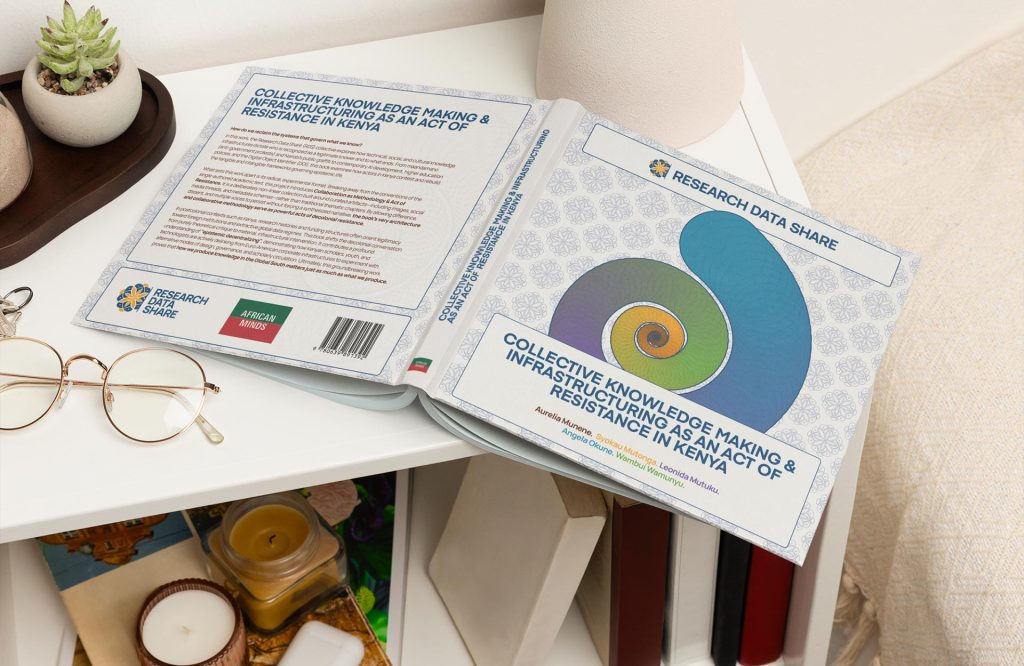
Collective Knowledge Making and Infrastructuring as an Act of Resistance in Kenya
How do we reclaim the systems that govern what we know? In this work, the Research Data Share (RDS) collective explores how technical, social, and cultural knowledge infrastructures dictate who is recognized as a legitimate knower and to what ends. From maandamano (anti-government protests) and Nairobi’s public graffiti to contemporary AI development, higher education policies, and the Digital Object Identifier (DOI), this book examines how actors in Kenya contest and rebuild the tangible and intangible frameworks governing epistemic life.
What is the 'Database as Book'
Rather than a single linear argument, this book assembles a collection of artefacts (documents, images, social media threads, platform screenshots, policies, and scholarly literature…) alongside individual essays and four shared analytical questions to which all contributors respond.
Readers can follow one author’s thread, trace a question across domains, or move between contributors in a nonlinear way. The authors call this a Database as Book: an appropriation of the books symbolic authority as a scholarly form, while reshaping its internal architecture. It is also a methodological claim that how knowledge is organised and stabilised is as political as what the knowledge says.
The Process
Curating this database-as-book project has been an unexpected journey of knowledge production, where meaning emerges not only from individual data points, but from the exercise of collective reflection and discourse.
The database-as-book project allowed us to weave one, or several, narratives from data points. As a collection of artifacts, commentaries, and annotations, they might not always make complete sense because they represent a cacophony of individual viewpoints, expertise, and biases. But when we deliberated on these objects together guided by analytical questions, we found a place of convergence and a shared foundation, woven together by common values, a deep uneasiness with the status quo of knowledge production in Kenya, and wholehearted desire to explore the otherwise and to re-member together.

Our Publisher
African Minds is an open access, not-for-profit, publisher of scholarly books. African Minds publishes predominantly in the social sciences and its authors are typically African academics or those with a close affinity with the continent. At African Minds the emphasis is less on the commercial viability of publications than on fostering access, openness and debate in the pursuit of growing and deepening the African knowledge base.
FAQs & Extras
This book examines knowledge-making as an act of resistance in Kenya. Five contributors, members of the Research Data Share (RDS) collective, explore how people push back against the systems that decide whose knowledge counts and where it circulates. The cases are deliberately varied: the June 2024 maandamano (citizen protests), Nairobi’s graffiti and street art scene, postgraduate peer-learning communities, AI development in Africa, and the politics of the digital object identifier (DOI) in scholarly publishing. What connects them is a shared concern with how infrastructures, technical, institutional, aesthetic, and social, shape who can be recognised as a knower, and how people intervene in those structures from within.
Rather than a single linear argument, this book assembles a collection of artefacts (documents, images, social media threads, platform screenshots, policies, and scholarly literature…) alongside individual essays and four shared analytical questions to which all contributors respond.
Readers can follow one author’s thread, trace a question across domains, or move between contributors in a nonlinear way. The authors call this a Database as Book: an appropriation of the books symbolic authority as a scholarly form, while reshaping its internal architecture. It is also a methodological claim that how knowledge is organised and stabilised is as political as what the knowledge says.
The book is published open access by African Minds and is freely available for download at www.africanminds.org.za. Printed copies can be ordered directly from African Minds (info@africanminds.org.za) or, for readers outside Africa, from African Books Collective: orders@africanbookscollective.com, P.O. Box 721, Oxford OX1 9EN, UK.
ISBNs:
978-0-6398913-9-2 (paper)
978-0-6398914-0-8 (eBook)
978-0-6398914-1-5 (ePub).
Yes. The RDS collective is available for panel discussions, public lectures, workshops, and podcast conversations. Areas of expertise include decolonial knowledge systems, open access and scholarly publishing reform, AI governance and data justice in Africa, urban art as cultural infrastructure, and experimental methods in collaborative research. Please reach out via African Minds (info@africanminds.org.za) or directly through the authors’ pages.