

By: Wambui Wamunyu
The construct of ‘knowledge’ exists within particular contexts, where political, economic and social interests converge to enable, stifle, or contain discourse about what people know, as well as how and why they know it. For many African countries, these interests are further complicated by colonial histories where the deliberate dismantling and diminishing of indigenous cultures and knowledge(s) (Bol & van Niekerk, 2024) have in contemporary times been countered by decolonial studies scholarship (such as Alapo & Doghudje, 2023; Carstens & Preiser, 2024); Gumbo, Knaus & Gasa, 2024; wa Thiong’o, 1986), which itself has been critiqued as an extension of colonial epistemology (Eze, 2024).
While acknowledging those various perspectives, this article focuses its argument on contradictions between the rhetorical and lived expressions of aspects of the Kenyan knowledge ecosystem, as set against the backdrop of a historic 2024 citizen protest (termed maandamano in Kiswahili). Policy statements that provide for access to equitable, quality education are negated by scholarly and media accounts of a range of issues including an unclear philosophical framework, underfunding, unequal resource allocation, poor implementation of education reforms, marginalization of learners from vulnerable socio-economic circumstances, and student and teacher unrest (Kihaki, 2025; Maisha Kazini, 2020; Malemba, 2024; Muricho, 2023; Ogawa, 2022; Osabwa, Malenya & Ndichu, 2021; Spice FM, 2024).
The article further recognizes the work the citizenry embarked on to assemble, share and provoke new knowledge and ways of thinking thus enacting a form of resistance to the status quo.
This work of assembly is termed ‘re-membering’ in this article, drawing from the work of Kenyan literary scholar Ngugi wa Thiong’o (2009). Often defined as a decolonial intellectual, wa Thiong’o framed colonialism as a weapon that dismembered African individual and collective identities, and so called for a reconstruction of the self and of community through language and collective memory ie ‘re-membering’. In my study of the June 2024 protests, I found the term ‘re-membering’ to be a useful conceptual framework through which to analyze the citizen-generated critiques of aspects of Kenyan life without necessarily making reference to ‘colonialism’ which ‘decolonial’ studies remain hinged upon (Eze, 2024).
The term ‘knowledge ecosystem’ may refer to the individuals, institutions, laws and policies that relate to knowledge production, expression and dissemination. In that regard, this article limits itself to one entity associated with knowledge, namely the formal Kenyan education system.
On June 25, 2024, thousands of Kenyans took to the streets across the country protesting against proposed legislation that sought to raise taxes. The protests, termed maandamano in Kiswahili, enabled citizens to forcefully give voice to their questions about wasteful or questionable use of public monies, while exposing weak and corrupt leadership, and dysfunction in multiple sectors (education, mining, agriculture, food security, etc). Social media platforms were taken over not just to share personal opinions but to rally people together to consider a new-look Kenya. Many of these citizens have paid for these questions with their lives and their personal freedom (Onyando, 2024; Wamunyu, 2024).
In Nairobi, some of the protestors gained entrance into parliament by breaching its gates where subsequently, the mace was reportedly stolen. The mace is a symbol of the parliament’s legislative authority, and a key element in the conducting of the business of the house. One observation in this article is that the taking of the mace was a decisive moment in the country’s history, symbolically illustrating a pivotal dismantling of institutional power and authority by and for the Kenyan people. The June 25, 2024 protest was a seminal event that served as the beginning of further protests later that year.
By focusing on purposively selected institutional and regulatory entities related to knowledge production, expression and dissemination, the article argues that even in matters related to the country’s knowledge ecosystem, the protest exposed extensive dissonance between the rhetoric and reality of aspects of Kenya’s knowledge ecosystem and the epistemic violence – a term associated with postcolonial theorist Spivak (1988) to mean the silencing or erasure of marginalized groups’ knowledge systems, perspectives, and agency -, the citizens have experienced at the hands of contemporary institutions in power.
Through a textual analysis of purposively selected legislative, policy, and media texts, the article posits that there has been a re-positioning of the citizen away from peripheral to central actor in Kenya’s knowledge ecosystem. The article concerns itself with the following questions:
- What is the rhetorical expression of Kenya’s knowledge ecosystem in the legislative and policy frameworks that pertain to the formal education system?
- What is the lived reality of Kenya’s knowledge ecosystem as exposed in the dissonance and dysfunction in the expression, production and dissemination of knowledge within the formal education system?
The article presents the discussion under three key sections which address the legislative and policy framing of knowledge in Kenya’s formal education system (rhetoric), Kenyans’ lived reality of the formal education system (reality), and posits that the 2024 protests enabled Kenyans to engage in a review and reconsideration of the education system (re-membering).
Rhetoric: Legislative and policy framing of knowledge in Kenya
Kenya’s legal, regulatory or policy frameworks broadly recognize ‘knowledge’ as a construct created and/or shared through multiple avenues including culture, the formal education system, science and research, and a broad range of information repositories such as indigenous communities, mass media, government agencies, and libraries.
Figure 1: Kenya Constitution (Source: Kenya Law: The National Council for Law Reporting), https://www.kenyalaw.org/kl/index.php?id=398
The Kenya Constitution (2010), Kenya Information and Communications Act (1998, Revised 2012), Kenya National Libraries Board Act (1965, revised in 1986, 2012), Knowledge Management Policy for Kenya (2022), the National Skills Development Policy (2023), Media Council Act (2013), National Museums and Heritage Act (2006, Revised 2012), Basic Education Act (2013), Education Act (1980, revised in 2012), , Public Archives and Documentation Services Act (2012, revised 2015), Protection of Traditional Knowledge and Cultural Protections Act (2016) and the Science Technology and Innovation Act (2013, revised 2014) are among a range of laws and policies that provide constitutional recognition, protection, promotion of and access to various forms of knowledge and intellectual property.
Formal education
Through budget allocation, policy discussion and societal expectation, Kenya’s formal education system is ranked higher than other types of knowledge sources. In each of the last three financial years for instance, the formal education sector has been allocated nearly 30% of the national budget, the largest share allocated to a particular sector. The funds have mostly been allocated towards funding of public education from primary to tertiary levels, salaries, and development of infrastructure (Wanjala, 2025).
Table 1: Monies allocated to Kenya’s formal education sector 2023-2026
| Financial year | Amount allocated (Billions in Kenya Shillings) | %age of national budget |
| 2025-2026 | 702.7 | 28 |
| 2024-2025 | 656.6 | 27.6 |
| 2023-2024 | 628.6 | 27.5 |
Source: Wanjala (2025)
Despite the funding, challenges continue to abound within the education sector. Kenya has among the highest primary school dropout rates in East Africa. It has experienced hastily introduced curriculum changes without piloting or sufficient preparation, frequent teacher strikes over pay and working terms, and is presently grappling with an unpopular new university funding model (Andati, 2024; Elimu Bora Working Group, 2025; Mumbi, 2025; Opanda, 2025, Otieno, 2025).
I found it interesting that in the range of documents analyzed, the definition of the term ‘knowledge’ is often presumed rather than explicitly defined. In addition, the conceptualization of matters related to knowledge often draw from external sources, be it in the theorizing or underlying philosophy.
The rhetoric in the legal and policy documents reviewed present a knowledge ecosystem that is equitable for all, protective of intellectual property, and recognizes different types of knowledge (such as indigenous, contemporary science, formal and informal). Separately, the lived reality of the knowledge ecosystem is that it is hierarchical, emphasizes market-driven approaches in the formal education system, has extensive inequalities in the access, quality and range of types of knowledge that citizens have, borrows heavily from external theorizing and reflection, has experienced multiple arbitrary changes, and has been marked by unrest such as by student strikes in high schools and universities, and protests by teachers against poor pay and working conditions.
Additionally, Kenya’s knowledge ecosystem treats institutions as the leading implementers of knowledge-related policy, takes a techno-deterministic approach to innovation and new technologies, has an exam-focused system that encourages memorization and conventional thinking over creativity and independent thought, and privileges English and Kiswahili in policy-making, teaching, learning, and other forms of knowledge management and exchange above other languages spoken by Kenyan communities.
Kenya’s Constitution is the legal reference that holds supremacy over all the other nation’s laws and policies. It recognizes, protects, promotes and requires equitable access to various forms of knowledge including: all forms of national and cultural expression through literature, the arts, traditional celebrations, science, communication, information, mass media, publications, libraries and other cultural heritage.The Constitution also acknowledges the role of science and indigenous technologies in the development of the nation, and protects the citizens’ individual or collective intellectual property rights. All rights as defined in the entire Constitution including those pertaining to the creation, sharing and use of knowledge belong to the citizen and are not granted by the State.
The legal and technical language of the Constitution can render it an abstraction, out of reach of the very citizen it seeks to protect. The promulgation of the Constitution in 2010 was preceded by years of drafting, horsetrading and intense political campaigning, largely among the powerful political leaders and civil society. The majority of citizens were passive observers of the process. When the new Constitution was finally passed via referendum, there were citizens who admitted to having voted not based on their own convictions but on the direction of a particular political leader.
But in the period leading up to and since the June 25, 2024 protests, there has been a shift where individual citizens have taken an interest in having knowledge about their societal rights and obligations, and the State’s rights, obligations and restrictions. Seeking knowledge in this context then becomes a choice for the citizen to appropriate their own agency about what they know and what they should know and so resist the ways in which they have been diminished or excluded by powerful individuals and institutions. The outcome is resistance to the epistemic violence that they – the citizens – have experienced at the hands of contemporary institutions in power.
During and after the June 25, 2024 protests, the language from the protests indicated that the citizenry were well aware of their constitutional rights. There were a series of posters that repeatedly referenced this line from the Constitution “The People Shall…”, an indicator of the sovereignty and centrality of the Kenyan citizen within the state.
A poster calling for peaceful protests (shown in Figure 2) provides an illustration of the agency the citizens’ appropriated for themselves. The constitutional guarantee of the people’s sovereignty was placed at the centre of the poster. The protest’s proposed date (July 16, 2024), motivating force (rage and courage), and intention (the hashtags #RutoMustGo and #OccupyCBD referred to a call for the president’s departure and the central business district as the protest venue) framed this centralized message. Beba maji, simu na flag (which means ‘carry water, your phone and a Kenyan flag’ in the nation’s lingua franca Kiswahili) was a creative use of symbols (water, phone and flag) to communicate their plan to peacefully state their demands as they had as much of a stake in the state as the governing authorities.
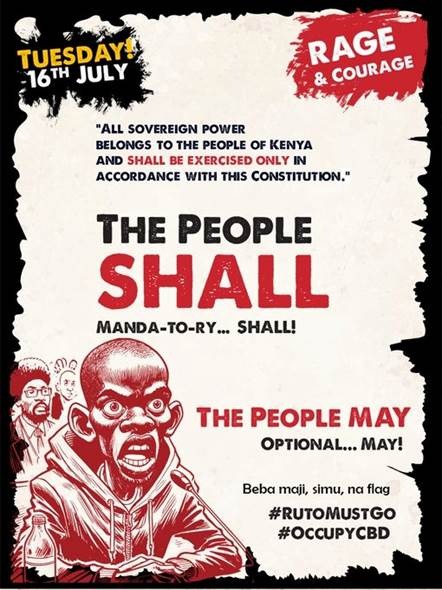
Figure 2: A poster that was circulated to call for protests after the initial June 25, 2024 protests. The poster drew from language in the Kenya Constitution that recognizes the citizen, not the State, as supreme.
Seeking knowledge in this context of awakened agency then becomes a choice for the citizen to appropriate their own agency about what they know and what they should know and so resist the ways in which they have been diminished or excluded by powerful individuals and institutions. The outcome is resistance to the epistemic violence that they – the citizens – have experienced at the hands of contemporary institutions in power.
Reality: Kenyan’s lived experience of the knowledge ecosystem
The June 25, 2024 protests (maandamano) were in themselves a form of knowledge production, expression and dissemination, giving voice to a simmering rage against the exposure of dysfunction across sectors, the State capture of the citizen’s mind (what we study, how we study, what policies we create, the (non) implementation of those policies, etc), confidence among citizens to question authorities (defined by age, institution, office, socio-economic status, political status, etc), and to speak to one another (horizontal discourse de-linked from institutional authority). The protests expressed a refusal to comply with official/State discourses around different aspects of Kenyan life.
In beginning to speak to one another and to question institutional authority, I found the citizens to be developing an increasing understanding of the nature of our knowledge ecosystem to be institution-focused, techno-deterministic, utilitarian (market-driven), arbitrary, inequitable, fragmented, bloated, and elitist.
Rhetoric versus lived experience
In a 2012 taskforce report (Ministry of Education (2012), the national philosophy of education is explained as follows: “Education philosophy emphasizes the provision of holistic quality education and training which involve the cognitive, psychomotor and affective domains. It further espouses the values of patriotism, equality, peace, security, honesty, humility, love, respect, tolerance and democracy” (Ministry of Education, 2012, p. 22). The emphasis is on achieving technical and social objectives through acquisition of knowledge and technical skills for the nation’s manpower needs, and the inculcation of perceived desirable social values (Shiundu & Omulando, 1992).
An analysis of the text and discussions on social media and elsewhere however, exposed a stark dissonance between the glowing rhetoric of policy and legislation, and citizens’ lived reality. An illustration of this awareness was seen on a poster circulating on social media (Figure 3) calling for protest in late June 29, 2024, following the initial June 25, 2024 protest. The June 29, 2024 poster had 14 listed demands, two of which directly pertained to education.
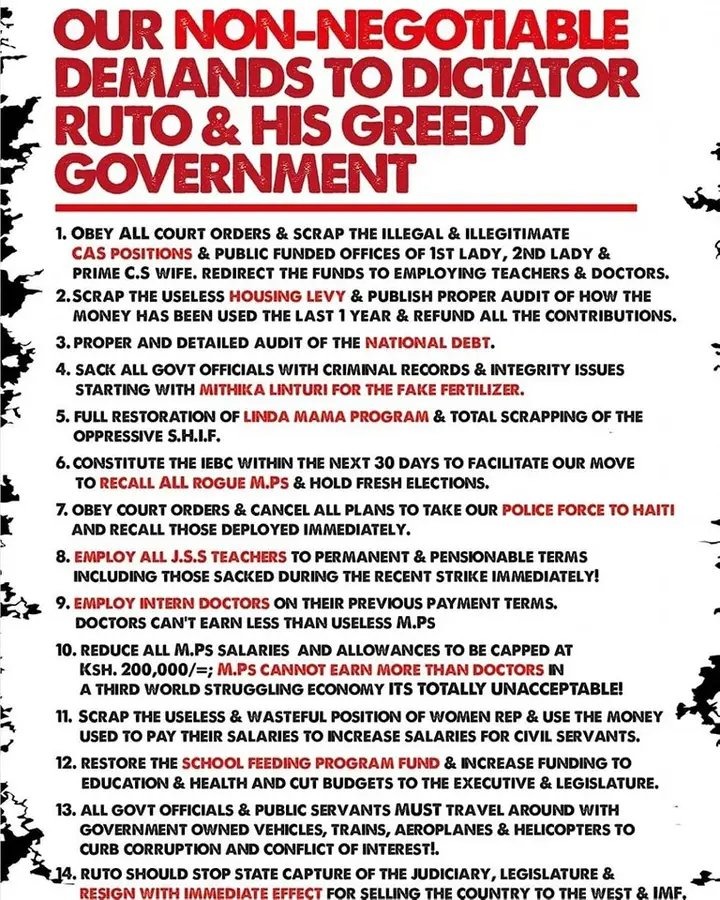
Figure 3: A June 29, 2024 poster listing 14 demands citizens wanted the government of President William Ruto to meet. This poster circulated on social media applications including X and Whatsapp.
The education related demands were eighth and 12th respectively on the poster as follows:
8. Employ all [Junior Secondary Schools] teachers to permanent and pensionable terms including those sacked during the recent strike immediately.
12. Restore the School Feeding Program Fund & increase funding to education & health and cut budgets to the Executive and Legislature.
In my review of the social media texts and policy documents, aspects of the national knowledge infrastructure (including legislation, policies, and data on public and private institutions) were not always easy to find or access, particularly for low-income, rural and marginalized communities. Corruption and inequalities in the access and quality of education learners across the nation experienced are among the challenges that have been exposed (Mwere, 2025).
Citizens began noting their observations that there was a privileging/ranking of:
– types of knowledge (with formal education elevated through budgetary and policy attention over indigenous/traditional, and cultural forms);
– languages in which knowledge is expressed and shared (with English often privileged English as the primary language of communication, Kiswahili to a lesser extent, and minimal use of local languages);
– geopolitical locations in which knowledge is articulated and shared (urban areas having more resources compared to rural areas); and
– institutions over citizens in who made decisions related to the knowledge ecosystem, its funding, and access.
Policies tend to emphasize the economic value of knowledge e.g. how knowledge will promote the economic agenda of the country, or how knowledge will add value to the labour market needs with little emphasis on the holisticism and social values that various scholars and commentators over the decades (such as Njoya, 2024; Shiundu &Omulando, 1992) have/had envisioned.
The knowledge ecosystem was also clearly tied to particular agendas such as foreign interests. For instance, when the United States of America’s government decided to cut funding for the US Agency for International Development (USAID), it exposed the extent to which Kenya’s social services, including education, are funded by foreign sources. In Kenya, the 2024/2025 national budget experienced a KSh. 52 billion shortfall that would affect the provision of teacher training, primary school literacy programmes, and learning scholarships among other areas (Kimani, 2025). A county governor (leader of one among 47 administrative units in the country) presided over the Oct. 8, 2024 launch of a community library which was funded by USAID (Figure 4).

Figure 4: The Oct. 8, 2024 launch of a donor-funded community library in Tharaka Nithi County (one of 47 administrative units in Kenya). The county’s governor (left) and the donor shaking hands at the event. Source: The Standard.
The maandamano provided a temporal space for citizens to collectively see and discuss the stark dissonance between the government’s glowing rhetoric and their (citizens’) lived reality. Social media was a particularly effective forum in enabling citizens to share and learn about what was going on in the country in multiple sectors. I recall my frequent surprise at the revelations that would emerge about conservation, agriculture, and corruption among other sectors, information that was found and shared by and among citizens through platforms such as TikTok, Whatsapp, and Youtube, generating further conversations and introspection offline.
However it is worth noting that these digital infrastructures which are owned by multinational for-profit companies, can be controlled through shut downs, throttling or other means with the intent to censor or limit discussion. To illustrate, a June 26, 2024 statement from a coalition of Kenyan civic technology organizations condemned the Kenyan government’s disruption of the Internet during the June 25, 2024 nationwide protest noting that the evidence pointed to “a government sanctioned disruption rather than a technical outage”. Further the statement read as follows:
“Kenya’s constitution and international human rights instruments safeguard the fundamental rights to freedom of expression, assembly, access to information, and picketing, which are violated by internet disruptions, censorship, and other information controls. By preventing citizens from engaging in public conversation and holding the government accountable, internet disruptions subvert democratic processes and the rule of law.”
Re-membering: What the maandamano did
Ngugi wa Thiong’o actively called for a systemic decolonizing within former colonial states on the African continent (1986) but also moved on to the concept of ‘re-membering’ (wa Thiong’o, 2009). In ‘Re-membering Africa,’ wa Thiong’o (2009) recognises the destruction the colonial experiment caused across all aspects of African life and calls for a restoration of collective memory. This article hinges itself on ‘re-membering’ rather than ‘de-colonising,’ choosing as its foundation not a turning away from elements of the colonial construct, but a turning to what the maandamano exposed to us: we had and have a knowledge ecosystem of value independent of, prior to and post the colonial experiment.
There are decisions the citizens made beyond going to the street to protest oppressive legislation and poor governance. By exposing the fragmented nature of our knowledge ecosystem, the dissonance between policy rhetoric and their lived reality, and the excessive power and control a small powerful elite had attained, the people began to re-member their constitutionally protected centrality.
The breaching of parliament and the reported capture of the mace served as a symbol of this agency, and was reflected in the stark differences between Kenyan policy and citizen discourses about the quality of our formal education system. Citizens called each other to meetings on social media – including one convened on November 7, 2024 (Figure 5) on the Kenyan education system – enabling critiques and reflective discourses what citizens experienced and what they considered as ideal
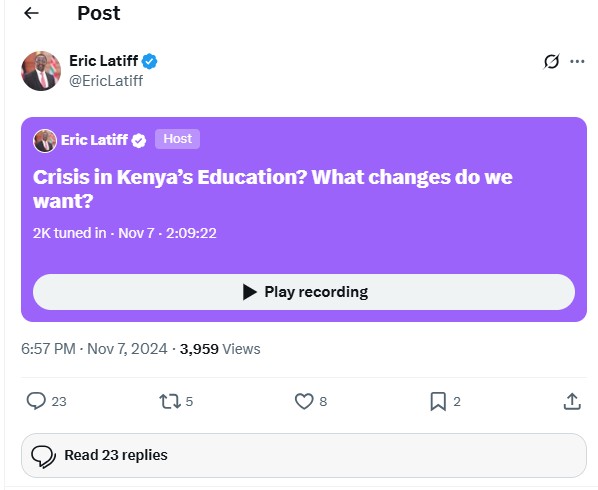
Figure 5: A screenshot of a conversation about Kenya’s education system on X Space hosted by a leading journalist on Nov. 7, 2024.
In talking together about the nation’s problems, and moving the conversations using multiple languages used across the nation and beyond urban locations to rural and marginalized communities, the people begun a resistance to the hierarchical, rigid, top-down knowledge ecosystem that excludes them (Maisha Kazini, 2025) by collectively beginning to assemble and re-member what they knew and sought to know.
The philosophical foundations of a re-membered knowledge ecosystem call for more holistic knowledge-related structures, a recognition and equalizing of different knowledge(s), knowledge -sharing in communal spaces apart from schools (such as community libraries, social halls, and social media), acknowledgement and equalizing of different knowledge sources (formal, informal, cultural, etc) and languages, and a more egalitarian approach in the funding of and access to places where knowledge is built and shared.
It is the people whose value of knowledge encompasses not only the economic or transactional, but also relationship and social communion. It is an acknowledgement that knowledge is for all and should serve the collective societal agenda.
References
Andati, O. (2024, February 29). Primary school dropouts have increased since 2021 – report. The Star. https://www.the-star.co.ke/news/2024-03-02-primary-school-dropouts-have-increased-since-2021-report
Carstens, M., & Preiser, R. (2024). Exploring relationality in African knowledge systems as a contribution to decoloniality in sustainability science. Ecosystems and People, 20(1). https://doi.org/10.1080/26395916.2024.2315995
Elimu Bora Working Group (2025, April 2). Ruto lied about court decision on university funding. Kenya Human Rights Commission. https://khrc.or.ke/press-release/ruto-lied-about-court-decision-on-university-funding/.
Eze, M.O. (2024). Decolonizing ‘decolonization’ and knowledge production beyond eurocentrism. The Monist, 107(3), 264-278.https://doi.org/10.1093/monist/onae013.
Khaki, M. (2025, April 30). Education stakeholders criticise reforms, claim they were rushed. The Standard. https://www.standardmedia.co.ke/article/2001517816/education-stakeholders-criticise-cbc-reforms-claim-they-were-rushed
Kimani, B. (2025, March 5). Kenya to lose KSh 52 billion over Trump’s funding freeze on USAID – Mbadi. Citizen Digital. https://www.citizen.digital/news/kenya-to-lose-ksh52-billion-over-trumps-funding-freeze-on-usaid-mbadi-n358677
Maisha Kazini. (2020, December 10). Maisha Kazini: Kenya’s education is still elitist, unequal and undemocratic (Part one). Maisha Kazini. https://www.youtube.com/watch?v=wOuHdF2Ylps
Maisha Kazini. (2025, July 7). Learning is work, knowledge is responsibility: A conversation on knowledge with Mordecai Ogada. Maisha Kazini. https://www.youtube.com/watch?v=7htCmEBuJ9o
Mumbi, L. (2025, January 1). From classrooms to the streets: Inside a tough and turbulent year for Kenyan teachers. Eastleigh Voice. https://eastleighvoice.co.ke/kuppet/101060/from-classrooms-to-the-streets-inside-a-tough-and-turbulent-year-for-kenyan-teachers
Muricho, Pius. (2023). Analysis of education reforms and challenges in Kenya: A historical perspective. International Journal of Current Innovations in Advanced Research,. 36-41. 10.47957/ijciar.v6i1.148.
Mwere, D. (2025, July 16). Audit reveals loss of billions in fraud involving ghost schools. Daily Nation. https://nation.africa/kenya/news/education/audit-reveals-loss-of-billions-in-fraud-involving-ghost-schools–5119596.
Njoya, W. (2024, August 2024). In Kenya, practical means mimicry. wandianjoya.com. https://www.wandianjoya.com/blog/in-kenya-practical-means-mimicry.
Njoya, W. (2025, March 15). Separate pathways are unequal pathways. wandianjoya.com. https://www.wandianjoya.com/blog/separate-pathways-are-unequal-pathways
Ogawa, M. Emerging inequality in Kenyan secondary schools: Dilemmas of educational expansion and quality improvement. Prospects 52, 453–468 (2022). https://doi.org/10.1007/s11125-022-09627-4
Onyando, W. (2024, June 22). We want justice for our son, says Rex Masai’s family. Daily Nation. https://nation.africa/kenya/news/we-want-justice-for-our-son-says-rex-masai-s-family–4665968.
Opanda, C. (2025, April 25). Ministry of Education changes CBC to CBE. Kenyans.co.ke. https://www.kenyans.co.ke/news/111422-ministry-education-changes-cbc-cbe
Osabwa, W., Malenya, F.L. & Ndichu, F.M. (2021). Kenya’s philosophy of education as the missing link between her education and the goal of developing skilled human resource. European Journal of Education and Pedagogy, 2(2), 37-42. https://doi.org/10.24018/ejedu.2021.2.2.61
Otieno, L. (2025, March 26). Win for gov’t as Court of Appeal reinstates university funding model. Citizen Digital. https://www.citizen.digital/news/win-for-govt-as-court-of-appeal-reinstates-university-funding-model-n359944
Spice FM (2024, September 2). Why Kenya’s Education System Is A Mess, Averting Strikes- Boaz Waruku. Spice FM. https://www.youtube.com/watch?v=iLOUpb3Pqks
wa Thiong’o, N. (1986). Decolonising the mind: The politics of language in African literature. James Currey/Heinemann.
wa Thiong’o, N. (2009). Re-membering Africa. East African Educational Publishers.
Shiundu, J.S. & Omulando, S.J. (1992). Curriculum: Theory and practice in Kenya. Oxford University Press.
Spivak, G.C. (1988). Can the subaltern speak? In Nelson, C. & Grossberg, L. (Eds.), Marxism and the Interpretation of Culture, pp. . University of Illinois Press.
Wamunyu, W. (2024, July 18). Bottom-up moral authority and communicative power: The Elephant. https://www.theelephant.info/analysis/2024/07/18/bottom-up-moral-authority-and-communicative-power/
Wanjala, E. (2025, June 12). Education biggest winner with SH. 702.7 billion budget share. The Star. https://www.the-star.co.ke/news/2025-06-12-education-wins-big-with-sh7027bn-budget-share.