

Introduction
Drawing on Henri Lefebvre’s right to the city (Purcell, 2016) and Walter Mignolo’s local histories/global designs (Mignolo, 2012), this paper argues that Nairobi’s graffiti scene, produced collectively by artists and communities on public walls, constitutes a knowledge infrastructure within art history itself, rather than an alternative to it. Against the backdrop of a Western gaze that has historically determined what counts as legitimate and authentic African art, Nairobi’s graffiti, through its political and commercial register, exercises its right to the city. Using articulations of the everyday, satirical depictions of corrupt politicians or campaigns for social advocacy, Nairobi’s graffiti demonstrates that the capacity to establish aesthetic logics has never been exclusively Western (Halliday, 2024). In Nairobi, as in other cities, the city wall is a legitimate site of art-historical production, equal to any art gallery.
My interest in this work is rooted in prior research on Nairobi’s public spaces — libraries, archives, museums, and gardens — and the ways their colonial legacies continue to sustain infrastructures of exclusion for the city’s citizens. Of equal concern is how Nairobians persistently reclaim these spaces and transform them in ways that delink from established colonial epistemologies, producing knowledge from the periphery rather than the centre (Mutonga and Okune, 2021). This paper is organised into three sections. The first offers a brief history of Western perceptions of African art, graffiti in Africa, and Nairobi’s street art scene. The second turns to four analytical questions, addressed through artefacts and critical commentary. The paper concludes with a provocation: when the wall becomes a knowledge infrastructure, what does the gallery become?
Context
To make this argument, a brief commentary on how art history’s perceptions of African art developed is required. As colonisation was spreading across Africa in the nineteenth and early twentieth centuries, European explorers, colonisers and traders collected African stools, masks, door panels, textiles and many other quotidian objects as fascinating curiosities, often overlooking their aesthetic, cultural and spiritual significance. This was a time when Europeans were fascinated by non-Western cultures (then referred to as ‘primitive’) as an antidote to modernity (Kasfir, 2020). African cultures and their expression through art were collected as a form of nostalgia for an imagined ‘state of nature’ when humanity was assumed to have lived in closer harmony with the natural and spiritual worlds. Subsequently, African artworks were collected for their authenticity – made in a recognised, unique style by African artists for African patrons. Anything made for commercial gain was considered inauthentic art in Western terms. In this way, the colonial project determined what counted as African art or craft and what was authentic or inauthentic. The consequences of this persist to the present, determining which African art forms and artists thrive in the global contemporary art market and which don’t. Any argument about African art as knowledge infrastructure must begin here. Furthermore, African contemporary arts did not emerge suddenly toward the end of the 20th century. Instead, they were built through bricolage, with new articulations merging with older colonial and precolonial African art genres. In many cases, new articulations of African art emerged and continue to materialise in cities and regions where they did not have to compete with an already existing tradition. Some of these cities where new articulations have emerged are Nairobi, Harare, Johannesburg, Addis Ababa, Dakar, and Entebbe. Art from these cities is creating new forms of contemporary African art (Kasfir, 2020). Graffiti is one such articulation — and among the most politically charged.
Graffiti emerged as a contemporary art form in Africa at the beginning of the twenty-first century. Described as a form of artivism that blends art and activism, graffiti has been shaped by the interplay of local tastes, traditions, socio-political contexts, and global influences. It has grown in popularity as a medium for political activism, with city walls reclaimed through art as a global social intervention (Aladro-Vico et al., 2018). Graffiti artists across Africa have used their art to dissent against the status quo, particularly during significant political events. Some of these included the 2010/11 Arab Uprisings in North Africa and the 2018/19 revolution in Khartoum, Sudan. In South Africa, graffiti was utilised to oppose apartheid regimes and more recent movements like #RhodesMustFall (Halliday, 2024). Graffiti artists also use it to foster community engagement and education, especially among the youth. For example, in Senegal, it has connected the youth to a movement to cleanse and beautify urban spaces. It is a broad canvas that artists use to challenge societal norms and engage in broader dialogues about who owns the city.
In Nairobi, graffiti has evolved since its inception. Its roots lie in the emergence of privately owned minibuses in the late 1950s and 1960s. These minibuses, popularly known as matatus, fostered a culture of artistic expression. By the 1980s and 1990s, matatu culture had absorbed hip-hop aesthetics, louder sound systems, and bolder graphics, laying the cultural groundwork for a distinctly Nairobian visual language. In doing so, it cultivated the audience and the artists that a publication like WaPI would later bring into focus. WaPI (Words and Pictures) was launched in 2006 with support from the British Council. It was published monthly and celebrated Nairobi’s hip-hop culture and emerging graffiti artists. The talents of some of Nairobi’s famous graffiti artists, such as Uhuru Brown, Smokillah, Swift, and Spray Uzi, were showcased at WaPI (Halliday, 2024). What began on the sides of minibuses has grown into a chorus of producers, artists, community members, and street walls — a scene whose full significance becomes visible only when examined on its own terms.
Artefacts and Critical Commentary
Analytical Question 1: How does Nganya culture establish its own aesthetic logic — and what does the matatu, as a site of artistic production, reveal about the relationship between everyday urban life and art-historical legitimacy?
The Nairobi art scene operates according to its own internal logic — canvases begin on walls and buses before, sometimes, finding their way into galleries. Nganya art is emblematic of this: emerging through matatus as a way of processing local and global pop culture, it was a deliberate departure from Western art forms in favour of surfaces that could better articulate the textures of everyday urban life. This is evidence of a mature aesthetic field that has built its own registers without seeking external validation. In Mignolo’s terms, Nairobi’s public art — on matatus and on walls — functions as a subaltern knowledge infrastructure: not merely a local alternative to Western aesthetic traditions, but a genuine epistemological other that is fully itself (Mignolo, 2012).
Artefact 1: Nganya Culture
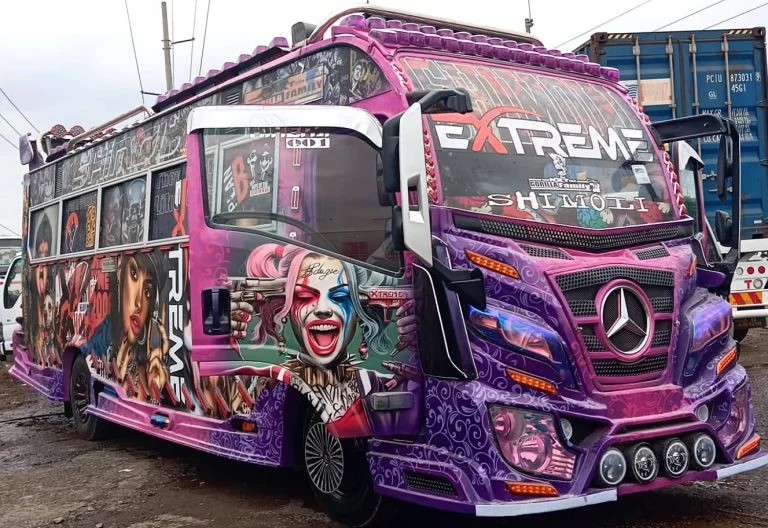
Matatus date back to the late 1950s and early 1960s, when private minibuses began filling the gaps in public transportation. The name derives from the original fare — three shillings, or mang’otore matatu in Kikuyu. Though basic at inception, by the 80s and 90s, pop culture had left its mark: hip-hop stickers, louder speakers, brighter colours. The 2000s brought full custom jobs, with owners spending millions on paint, sound and lighting — and a new word: Nganya (from manyanga, meaning flashy), reserved for the most decked-out rides.
Today, Nganyas are known for speed, comfort and fierce loyalty among riders on specific Nairobi routes — Embakassi, Rongai and Umoja. For many creatives, they double as affordable transport and a platform for art, street recognition and political expression.
Source:https://suremediamagazine.com/2025/12/21/discover-the-art-and-culture-behind-kenyas-iconic-nganyas/
Artefact 2: Woodcut Prints of Street Scenes in Kenya
Dennis Muraguri, originally from Naivasha and now based in Nairobi, makes art inspired by matatus. His most celebrated work, exhibited internationally, is his woodcut prints. It is a technique he developed in direct response to the stencils and stickers used by nganya decorators, translating their flat graphics into a printmaking language. “My thinking is that without the people, it’s just a bus. But with the people, it becomes a matatu.” Despite his notoriety, Muraguri is quick to defer to the nganya artists who inspire him: “It’s an insult to think I could paint one. They do it better than I ever could. It’s communication. It’s a reflection of what’s happening in the world and locally.” From American movie stars to European football teams, he argues, nganya artists are firmly on the pulse of global pop culture — a point the artists themselves make plainly: “If you’re not on a matatu, you’re not famous enough.“
Source:https://wepresent.wetransfer.com/stories/dennis-muraguri-woodcut-matatu-prints
Analytical Question 2: How did the MaVulture campaign exercise the right to the city — and in what ways does politically interventionist graffiti constitute a form of civic participation that operates outside, and in deliberate refusal of, institutional authorisation?
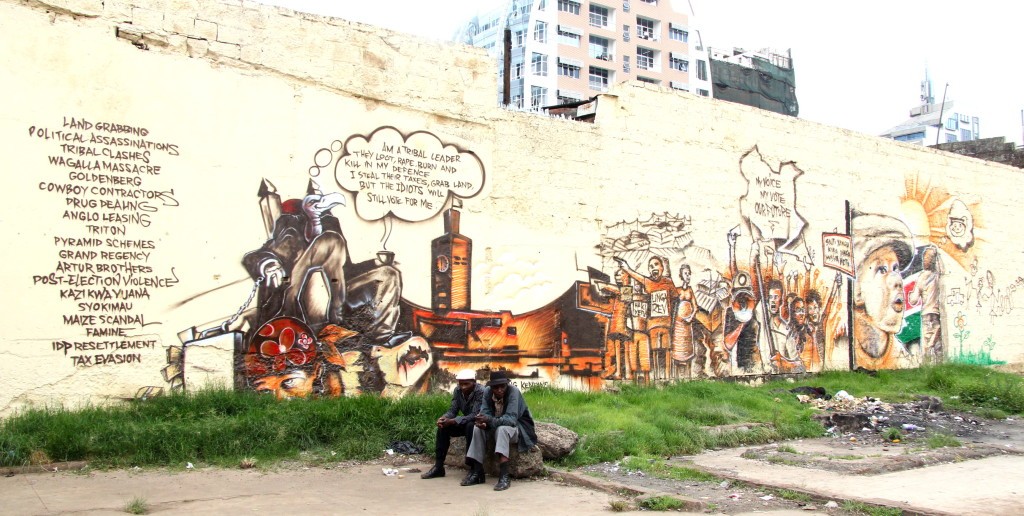
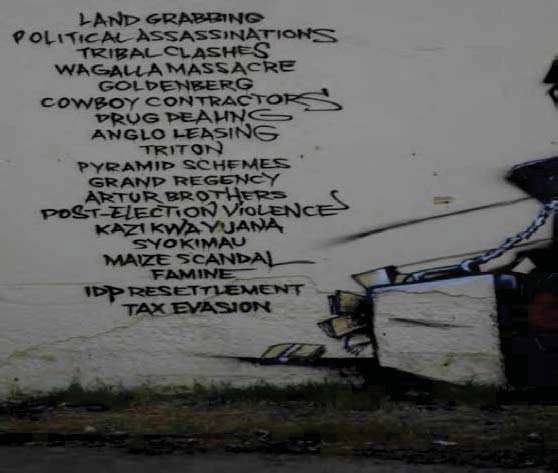
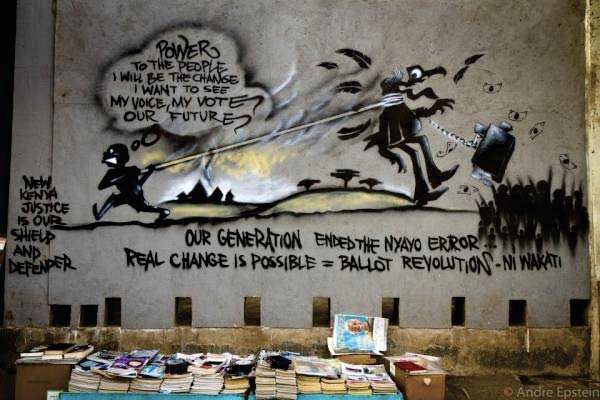
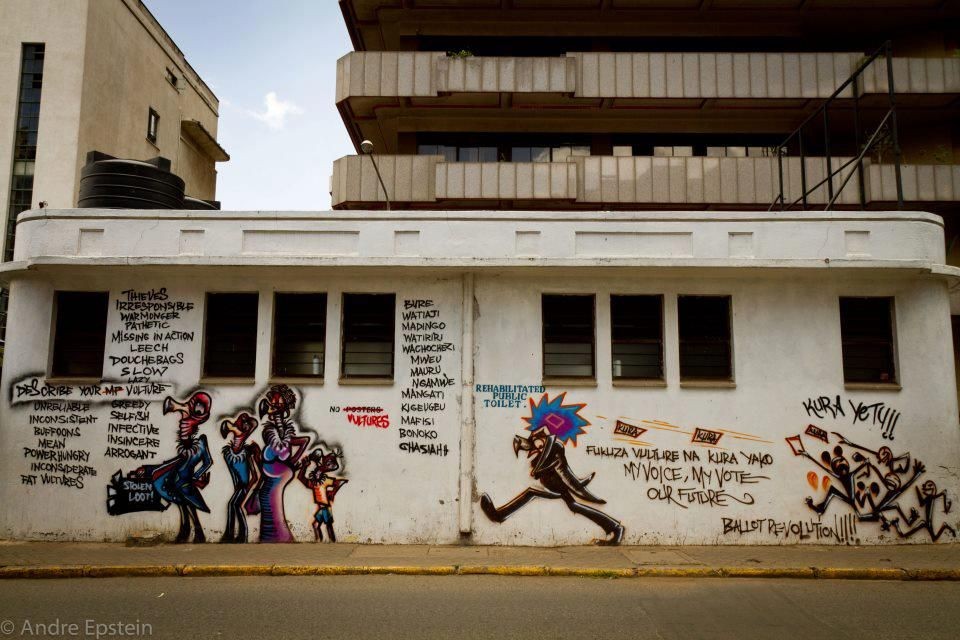
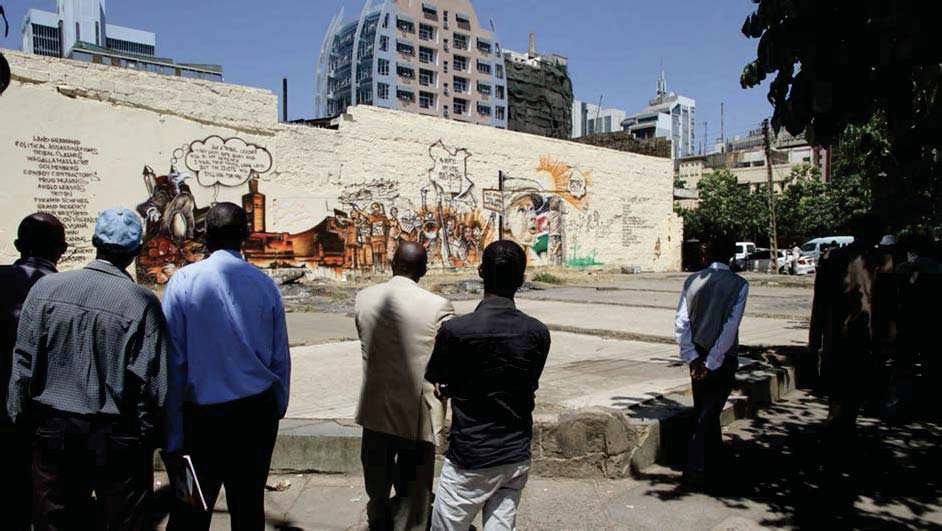
The MaVulture Campaign was a graffiti campaign between 2012 and 2013 led by the activist Boniface Mwangi, alongside graffiti artists Uhuru Brown, Bankslave, Smokillah, Swift, and Kerosh. They painted graffiti murals in Nairobi’s central business district that depicted Kenya’s corrupt members of parliament (MPs) as vultures who preyed on the weak. Acting under the cover of darkness, they famously depicted the greed of Kenyan MPs, who, despite earning high salaries, continued to demand more money, while a majority of Kenyans struggled economically – a behaviour the artists termed as “eating” the public. Painted across 41 locations in Nairobi’s central business district, the works broke a conspiracy of silence by saying what mainstream media would not. As Mwangi put it, “Some laws have to be broken for people to be heard” (Halliday, 2024). Henri Lefebvre’s “right to the city” offers a productive lens for reading the MaVulture murals. His framework was centred on citizen empowerment through active participation in the use and creation of urban space, encompassing creative activity, the imaginary and play (Lefebvre, 1974). This was what the MaVulture artists did. They entered Nairobi’s central business district without institutional authorisation and reclaimed walls as a civic creative act. Their murals were not vandalism – they were participatory civic engagement that did not wait for permission (Halliday, 2024).
Artefact 3: The Vulture Politician © Boniface Mwangi
Artefact 4: Major scandals committed by the vultures © Boniface Mwangi

Artefact 5: The Leaders We Want © Boniface Mwangi
Artefact 6: People’s Power Strangles the Vultures © Andre Epstein
Artefact 7: Graffiti on the outside of public toilets © Andre Epstein
Artefact 8: The Public Engaged by the Graffiti © Boniface Mwangi
When asked why graffiti was the right medium, Mwangi said: “Art is very complex…but graffiti is very simple at the same time. The power of art makes you stop and think, makes you stop and feel. Art goes beyond gender, age, class, race, and sexual orientation. Because art drives life. Without art, there is no life.“
The campaign was warmly received by the public but provoked outrage among parliamentarians, leading to its swift removal by local authorities. Simultaneously, images spread widely across blogs and social media, sparking debate about corrupt governance in Kenya and beyond. Hashtags followed: #LetMwangiDraw and #KenyaNiKwetu. The vulture image took on a life of its own, later appearing in music videos advocating for peace and the power of ordinary Kenyans to change the status quo.
Reflecting on the campaign, Mwangi said: “What we are doing is planting a lot of seeds — some will germinate, and some will die, but eventually we are going to get a harvest.” MaVulture is widely regarded as heralding a new era of political activism in Kenya — direct, public, and deliberately far removed from the subtlety of the studio. Fellow artist Smokillah captured it plainly: “We are a vessel that gives a voice from the people (Halliday, 2016).
Analytical Question 3: When graffiti enters the commercial register — through hotel commissions and corporate partnerships — does it extend or exhaust its claim to the city, and what does this tension reveal about the sustainability of artivist practice?
Nairobi’s graffiti artists — Wise Two and Kerosh among them — do not position themselves in relation to a Western tradition. They paint because the wall is there; the city is a living surface, and they are among its authors. This is how they enact their right to the city: not merely occupying urban space but producing and shaping it according to the needs and logics of those who actually inhabit it. The two projects discussed here — one for Ibis Styles Hotel, the other for Apple Music — raise a pointed question: does it matter if the canvas is a hotel wall rather than a community wall, and does the commercial nature of these commissions dilute the artists’ prior activism? The answer resists a binary. Commercial collaborations are part of these artists’ broader oeuvre; they sustain practice materially, afford a livelihood, and — crucially — generate the capacity to contribute to community-driven initiatives (Halliday, 2024). The wall does not become less political because someone paid for it.
Artefact 9: Ibis Styles Hotel (a), Westlands, Nairobi, © Asif Khan
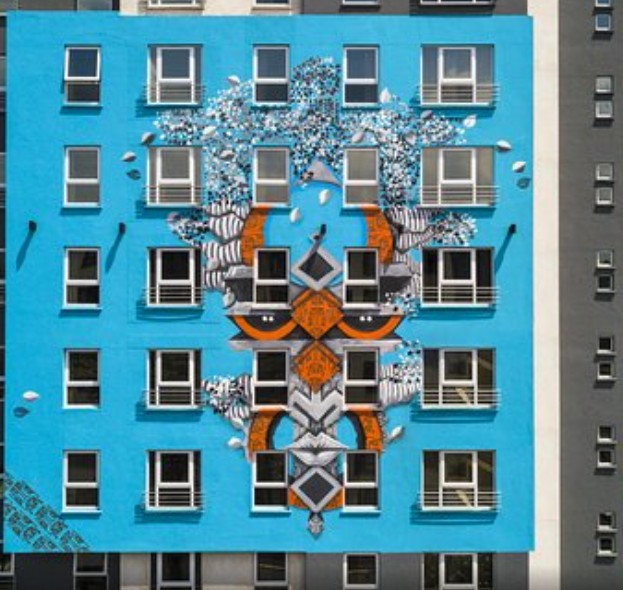
Artefact 9: Ibis Styles Hotel (b), Westlands, Nairobi, © Asif Khan
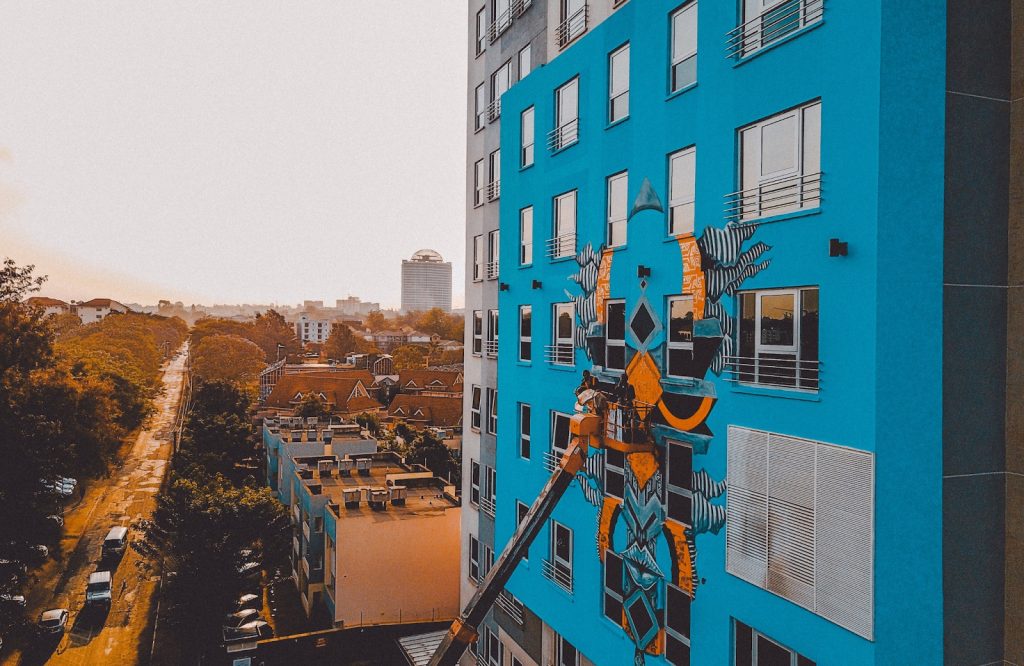
Artefact 9: Ibis Styles Hotel (c), Westlands, Nairobi, © Asif Khan
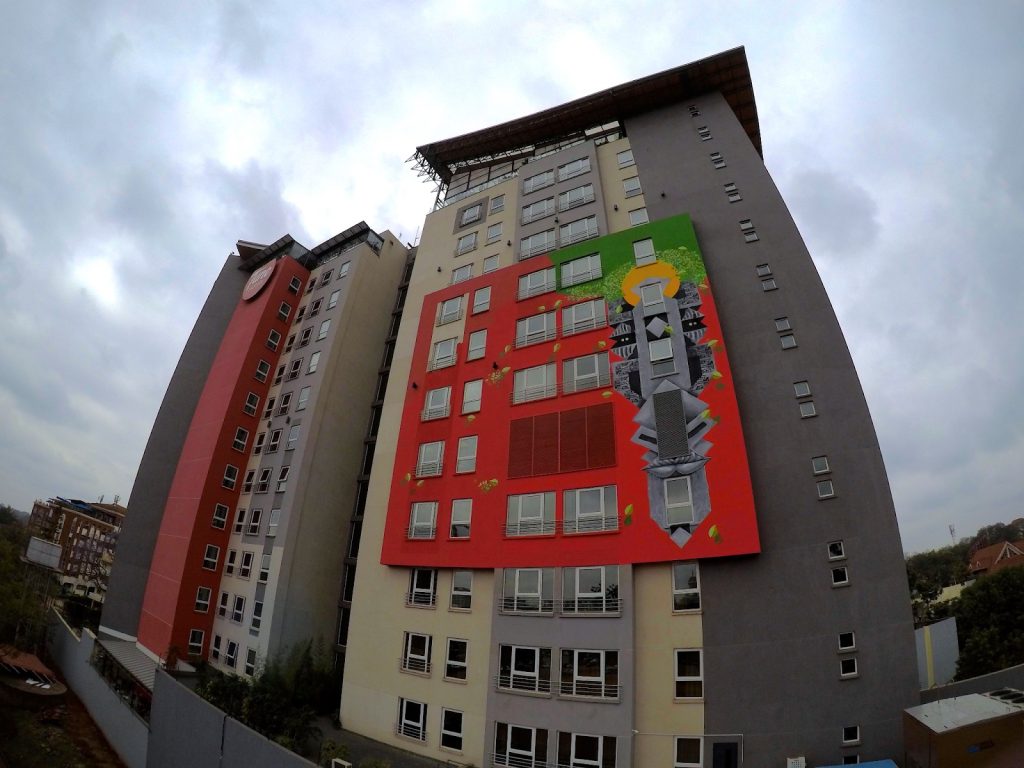
In October 2017, WiseTwo and Kerosh, both Nairobi-based graffiti artists, gained international repute for painting two murals that adorn the Ibis Styles Hotel in Westlands, Nairobi, Kenya. The two murals, at the time, became the largest of their kind in Eastern and Central Africa. Wise Two, whose real name is Bhupi Jetwa, and Kerosh, one of the artists in the MaVulture campaign, spent two weeks working 10-hour days to complete the murals. Reflecting on the challenge, Wise Two said, “It’s a humbling feeling. Something keeps telling me to keep pushing the boundaries…” The aesthetics have become familiar with Wise Two’s aesthetic style – intricate facemasks painted in bright and explosive colours, evoking tribal elements and contemporary complexity.
The mural designs were inspired by two canvases that WiseTwo exhibited at a solo show in Paris in 2015. Each mural on the walls of Ibis Styles Hotel is 15 metres wide and 15 metres tall, both of which are more than 35 metres above ground.
Source:https://www.kenyanvibe.com/kenyan-graffiti-artist-wisetwo-paints-largest-murals-in-east-africa/
Artefact 10: Sound Plaza (a), Woodvale Groove, Westlands, Nairobi, Kenya
Commissioned Mural by Apple Music for Sauti Sol’s Midnight Train Album cover, 2020, Nairobi, Kenya © Rich Alela and James Wamathai
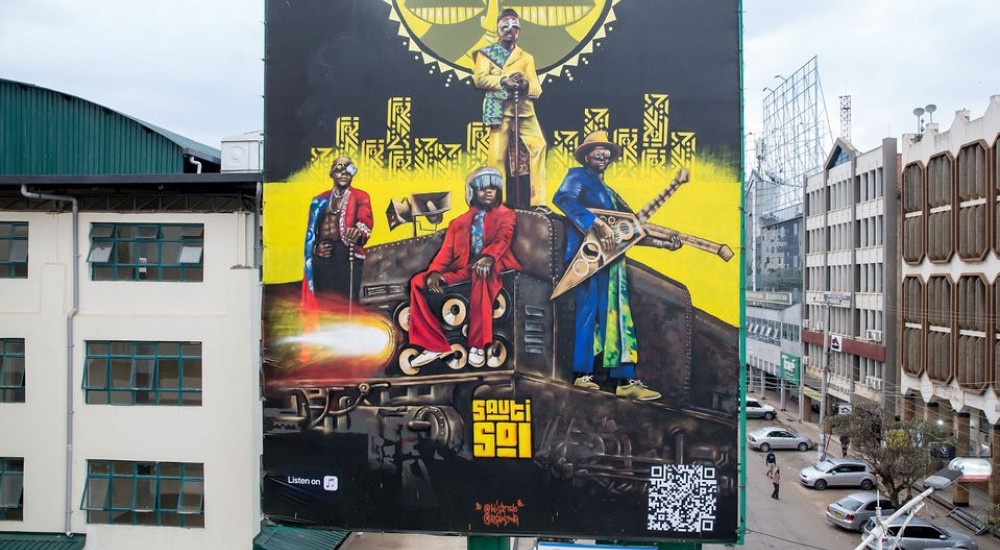
Artefact 10: Sound Plaza (b), Woodvale Groove, Westlands, Nairobi, Kenya
Commissioned Mural by Apple Music for Sauti Sol’s Midnight Train Album cover, 2020, Nairobi, Kenya © Rich Alela and James Wamathai
Artefact 10: Sound Plaza (c), Woodvale Groove, Westlands, Nairobi, Kenya
Commissioned Mural by Apple Music for Sauti Sol’s Midnight Train Album cover, 2020, Nairobi, Kenya © Rich Alela and James Wamathai
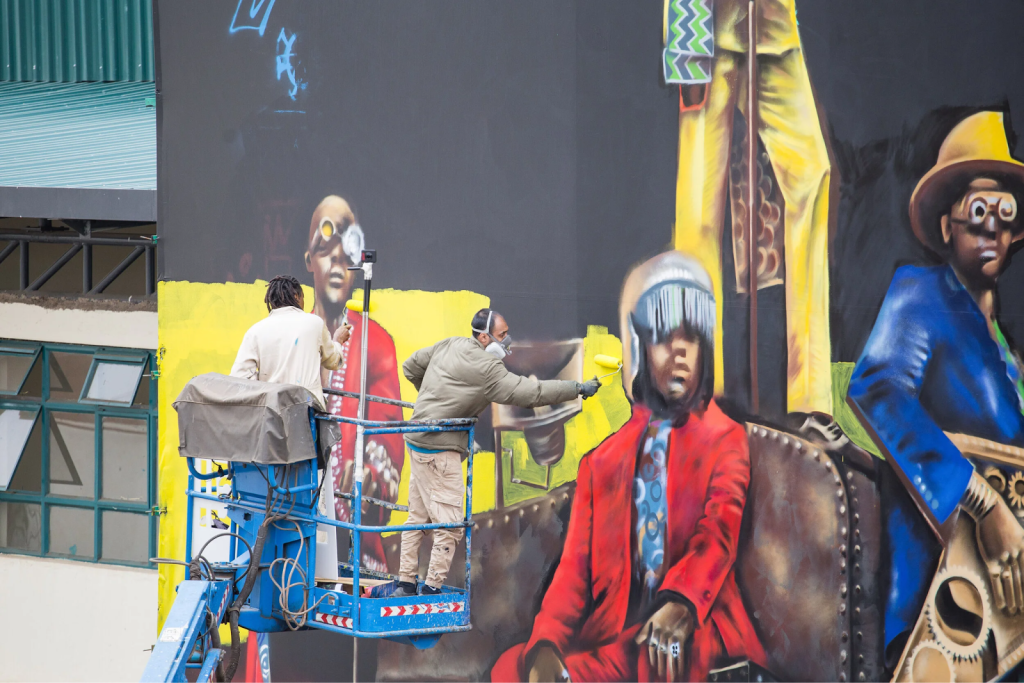
In 2020, building on the success of the Ibis Styles murals, WiseTwo was commissioned by Apple Music to paint Sauti Sol’s Midnight Train album cover onto a Westlands wall, this time alongside Kerosh and Esen. The piece — rendered in graffiti and mural techniques — was designed to capture the group’s fusion of traditional Kenyan influences, energetic rhythms, and deeper cultural legacies. Its warm public reception confirmed what the Ibis Styles commission had already suggested: that graffiti in the commercial register need not abandon its civic function. Here, the wall became a site of cultural celebration, affirming the legitimacy of Kenyan artistic production on its own terms.
Source: https://www.wisetwo.org/murals/applemusicsautisol
Analytical Question 4: How does the Talking Walls project in Korogocho refuse individualism as an organising principle — and what model of collective authorship does community graffiti offer for theorising social space in informal settlements?
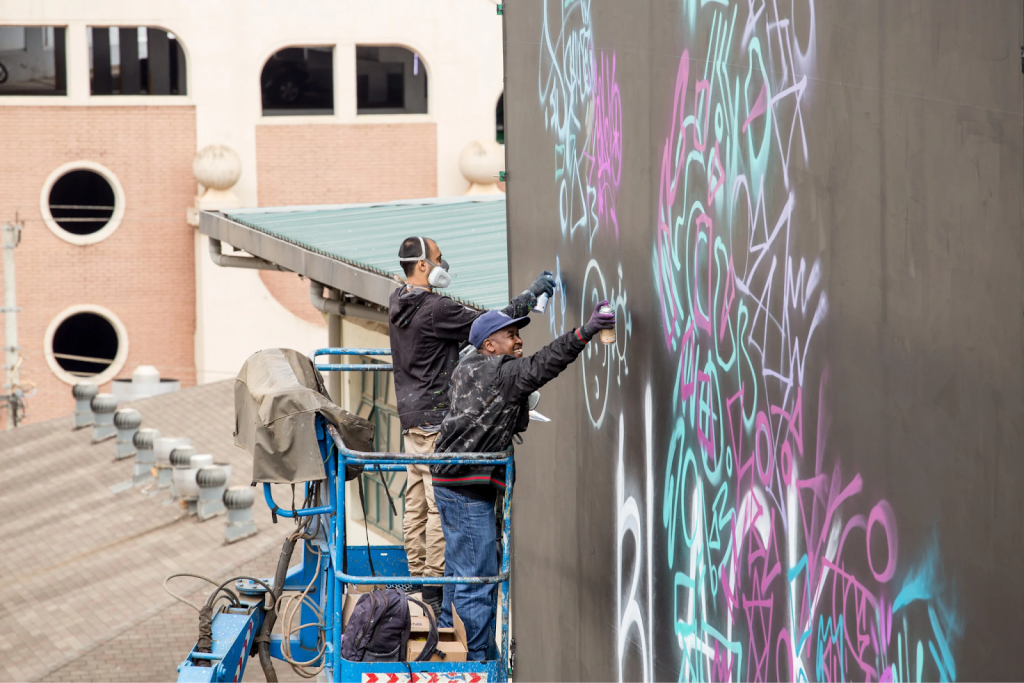
Hope Raisers Initiative (HRI), based in Korogocho — Nairobi’s third-largest informal settlement — has since 2014 painted more than 1.5km of walls across public spaces, working alongside community members in an area historically marked by gender-based violence, crime, and drug abuse. Their project, Talking Walls, facilitates dialogue between graffiti artists and Korogocho residents about art as a tool for social transformation. What distinguishes the project is its deliberate rejection of individualism. As Kerosh puts it, “It is a community project; you can’t just come and tag your name. You have to consider something that the community will understand, appreciate, and something that they will be proud of, something that they want to own and defend.” This orientation has cultivated genuine collective ownership. In Hartman’s terms (Hartman, 2019) the artists and community members are dancing within the enclosure of dispossession — improvising, collaborating and leaning towards the futures they want for themselves. Through Talking Walls, participation becomes the right to influence decisions shaping Korogocho’s public life, while appropriation becomes the right to access, occupy, and transform spaces according to the community’s own needs (Stickells, 2011).
Source: https://korogochostreetscapes.wordpress.com/portfolio/talking-walls/
Artefact 11: Graffiti Artist Kerosh, Painting for the Talking Walls Project, Korogocho, Nairobi, Kenya

Conclusion
The late Professor Ali Mazrui believed that politics was no place for the artist: “No great artist has a right to carry patriotism to the extent of destroying his creative potential” (James, 2025). Nairobi’s artists have answered that provocation differently. Whether through Nganya art that laid the groundwork for future articulations of public expression, murals that protest corruption, commercial commissions that celebrate Kenya’s rich artistic culture, or community projects that seek to reinvigorate amidst dispossession, they have never waited for permission — from the state, from institutions, or from art history itself.
That refusal is the argument. When the wall becomes a knowledge infrastructure, new ways of being in the world become possible — beyond the colonial, Western determination of what counts as art and who gets to make it. In Nairobi, it always has.
References
Aladro-Vico, E., Jivkova-Semova, D., & Bailey, O. (2018). Artivism: A new educative language for transformative social action. Comunicar, 57, 9–18. https://doi.org/10.3916/C57-2018-01
Chonghaile, C. N. (2012). Kenyan Graffiti Artists Step up Battle Against ‘Vulture’ Politicians. The Guardian. https://www.theguardian.com/world/2012/mar/21/kenya-graffiti-artists-politicians-vultures
Fanon, F. (2004). The Wretched of the Earth. Translated by Richard Philcox. New York: Grove Press.
Halliday, C. (2016, March 8). Street art: Taking art to the people. Africanah.org. https://africanah.org/street-art-taking-art-to-the-people-2/
Halliday, C. (2019). Animating Political Protests through Artivism in 21st century Nairobi, Kenya. The Journal of Law, Social Justice & Global Development, 24. https://doi.org/10.31273/LGD.2019.2406
Halliday, C. (2024). Graffiti as a Catalyst for Urban Creativity: Exploring Agency, Participation, and the Right to the City in Nairobi. European Journal of Development Studies, 4(6), 25–37. https://doi.org/10.24018/ejdevelop.2024.4.6.391
Hartman, S. (2019). Wayward lives, beautiful experiments: Intimate histories of riotous Black girls, troublesome women, and queer radicals. W. W. Norton & Company.
James, H. (2025). How Gen Z used art culture to fuel protest in Kenya. People Daily Digital. https://peopledaily.digital/lifestyle/how-gen-z-used-art-culture-to-fuel-protest-in-kenya
Kasfir, S. L. (2020). Contemporary African art (2nd ed.). Thames and Hudson.
Kenya’s Artists Rise in 2025 Protests. (2025, June 27). Mimeta. https://www.mimeta.org/mimeta-news-on-censorship-in-art/2025/6/27/kenyas-artists-rise-in-2025-protests
Lagat, F. (2025, October 31). Matatu mania: Why Nairobi’s nganya culture is therapy Gen Z won’t let go of. People Daily. https://peopledaily.digital/lifestyle/matatu-mania-why-nairobis-nganya-culture-is-therapy-gen-z-wont-let-go-of
Massing, J. M., & Danimbe, J. (2025). Sensibilités vaudou dans l’art contemporain d’Afrique. Fondation Blachère.
Mignolo, W.D. (2000). Local Histories/Global Designs: Coloniality, Subaltern Knowledges, and Border Thinking.
Njugi, F., & Ogwa, T. (2024). Kenya’s Gen Z and the Art of Protest. The Elephant. https://www.theelephant.info/analysis/2024/10/18/kenyas-gen-z-and-the-art-of-protest/
Ombati, M. (2015). Public artworks: Creative Spaces for Civic and Political Behaviour in Kenya. The Australasian Review of African Studies, 36(1), 29–50. https://search.informit.org/doi/10.3316/informit.161626523109358
Purcell, M. (2016). Possible Worlds: Henri Lefebvre and the Right to the City. Journal of Urban Affairs, 36(1), 141–154. https://doi.org/10.1111/juaf.12034
Stickells, L. (2011). The right to the city: Rethinking architecture’s social significance. Architectural Theory Review, 16(3), 213–227. https://doi.org/10.1080/13264826.2011.628633