

By: Aurelia Munene
Introduction
The experiences of students pursuing their postgraduate education in Kenya mirror the broader struggles of post-colonial Africa concerning identity, epistemic justice, liberation, ideological tensions, anti-intellectualism (both generally and in universities), and feelings of displacement or resistance. Some examples of these include; (Mamdani 2007) on neoliberalism, commercialisation and higher education; Waninga 2025 knowledge production , power and epistemic hegemony; Daley 2023 defiant scholarship; (Omedi et, al 2025) delayed completion in graduate studies; (Muthiani et,al 2023) research skills and completion rates in postgraduate education. These struggles manifest at the intersection of historical, ideological, political knowledge concerns (Munene 2024).
Through selected artifacts, rather than focus on the widely discussed challenges in postgraduate education in Kenya, like delays, supervision gaps, financial and workload barriers, I focus on discussing how, by carefully assembling a postgraduate peer-led collective learning community outside the university, we are opening space for knowledge production in ways that are more dignifying, affirming and supportive. Infrastructuring this community of practice is an act of resistance to the existing hierarchical knowledge structures present in postgraduate education in Kenya. The motivation for this work has been interactions with postgraduate students in Kenya whose voices have been systematically silenced by existing knowledge infrastructures within universities. Knowledge infrastructure in the context of this essay represents the institutional, social, political and cultural systems and structures that shape how knowledge is understood, produced, used and whose voice counts.
Resistance in this essay begins by illustrating both intentional and unintentional processes through which postgraduate student voices are marginalised within formal university structures. These processes can be understood through a Foucauldian analysis of power, discourse and disciplinary systems that determine who speaks and who is heard. The essay then moves on to highlight Eider Africa as an emergent alternate re(imaginative) knowledge infrastructure that resists these marginalisation by nurturing peer to peer mentorship spaces and research journal clubs for African scholars. This initiative is inspired by works of De Sousa Santos (Santos 2014) on epistemic injustice and the work of Mbembe (2016) on hegemony in knowledge. The essay then highlights the tensions and challenges of sustaining these alternative knowledge infrastructures. Although they still operate and depend on the same contexts that are deeply rooted and rewarded by neoliberal and colonial knowledge systems of funding and legitimacy, they remain important spaces to maintain because they hold space to practice alternative, non-hierarchical ways of relating to each other and to knowledge itself.
Analytical Questions
- How do current power dynamics in postgraduate education, both subtle and overt, contribute to the silencing of student voices?
- In what ways has Eider Africa, through its extensive experimentation of a research collective, attempted to resist postgraduate power dynamics, moving away from dominant approaches?
- What specific challenges has Eider Africa faced over the past 7 years, and what do these challenges reveal about the implications for developing alternative models of postgraduate education in Africa?
Analytical Question 1: How do current power dynamics in postgraduate education, both subtle and overt, contribute to the silencing of student voices?
Voice and post graduate education.
Artifact 1: Eider Africa Research Conversation Open Day held in 2017.
Critical Commentary: The artifact is a reflection on a gathering of postgraduate students drawn from different universities, who came together to meet other researchers, peers and seek solutions for the challenges they face in their studies. I organised this event inspired by two university students I had met prior who mentioned how they are still stuck with their research papers at Masters level. I decided to hold an event to understand these challenges deeper and invite seasoned researchers to motivate them. Drawing together these students and meeting them outside the university was the beginning of the acts of resistance.
The first organised research collective at Eider Africa was called Research Conversation Open Day. The invitation read as follows, “Join a team of seasoned researchers on 26th August 2017 on a Saturday morning 9.30-12.30 pm for an Open Day Session with Public Health, Health Science and Social Researchers. The venue is at the British Institute in Eastern Africa (BIEA)- Lavington Nairobi.”
Eider Africa reached out to students through Eventbrite and emails. The overwhelming response, with over 80 postgraduate students from various universities attending was surprising. From the discussions, beyond the shared difficulties in completing their research, a striking commonality emerged: a pervasive sense of not being heard. Students felt unable to articulate their preferences regarding research topics, the kind of feedback they desired from supervisors, or the methodologies they wished to employ. This inability to voice their needs left many feeling profoundly “stuck” in their academic journeys. Feedback from one of the students who attended the event was that “at least we have a space we can speak.” This began my thinking more deeply about voice and spaces to help people speak, reflect, connect and learn together. From this event several smaller research discussions events were hosted by Eider Africa at different venues.
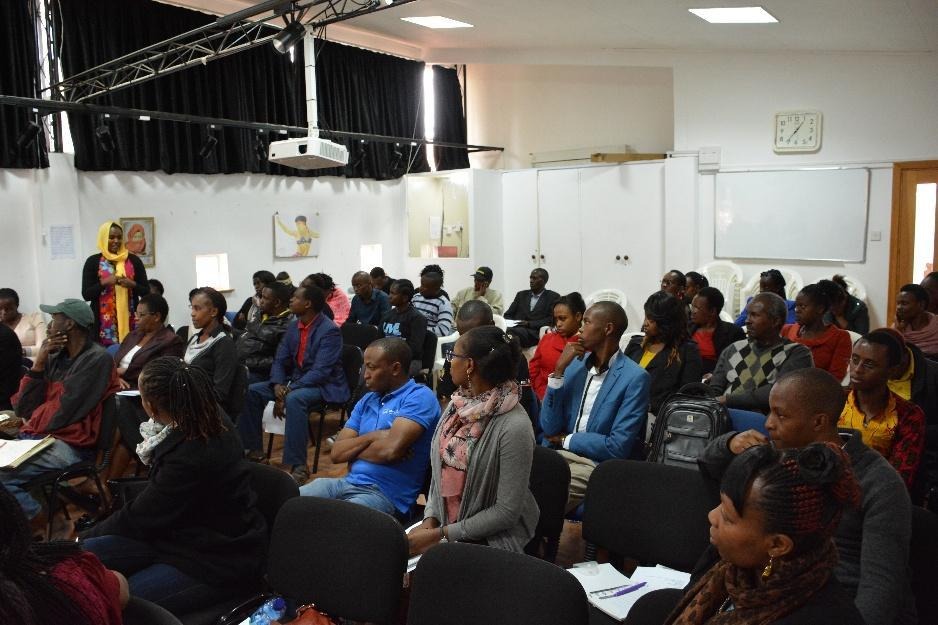
Fig 1: Research Collective Open Day 2017.
Why do postgraduate voices matter in their own learning?
Continuing from the reflection of the Research Conversations Open Day, Having ‘voice’ implies that one has a language in which to give expression to one’s authentic concerns, that one can recognise those concerns, and that there is an audience of significant others who will listen to those concerns.… voice is already there, already critical, regardless. of whether the outside world allows it expression Sound, Presence, and Power: “Student Voice” in Educational Research and Reform. Curriculum Inquiry. Universities often unintentionally silence certain voices, a process that mirrors and reinforces existing power imbalances. This contributes to the broader subjugation of specific voices within the wider knowledge infrastructures. This issue is deeply intertwined with pedagogical approaches, echoing Paulo Freire’s seminal work, “Pedagogy of the Oppressed.”
I suggest that this suppression can lead students to a profound loss of self, resulting in confusion, grief, and dissatisfaction. However, students do not passively accept this silencing. They resist in various ways, from actively pushing back against power inequalities to silently enduring them. This silent endurance, often undertaken just to complete their studies, is, in essence, a form of “exiting in silence” which is a powerful coping mechanism in the face of difficult circumstances. And this is how most students I meet are existing.
But what does that mean for knowledge production, infrastructure, sharing and interrogation in Africa? Often, academic spaces, instead of fostering new African scholarly voices, contribute to a loss of power that continues to silence Africans in global thought leadership and ideological influence. Some of these silencing manifests in what Mordecai Ogada calls ”academic scarecrows”- Kenyan doctorate students or lecturers without a philosophical foundation and deep reflexivity. Of course, these issues are beyond individual failure but a reflection of the complex influences of neoliberal, colonial capitalist processes that have shaped universities over the last several decades, Ochwa-Echel 2013.
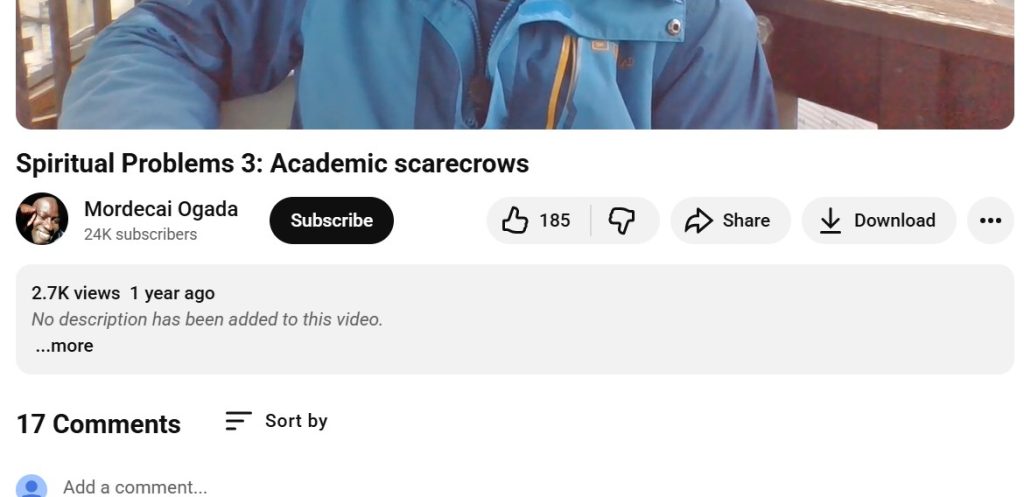
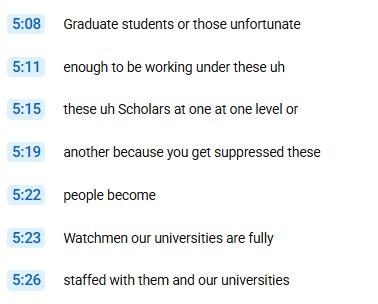
Fig 2: Mordecai Ogada Youtube Page Screen Shot: Spiritual Problem 3. Academic Scare Crows
This silencing is also seen in how students treat research participants as mere objects for extractive knowledge, prioritizing graduation over genuine engagement. Such relationships further displace and make invisible community voices and contributions to research.
Reflecting on this first session many years later, I am also experiencing my ‘stuckness’ in the system and below is my reflection about my voice in postgraduate education and my research practice in Kenya.
Losing my voice through and in postgraduate education and research practice.
It is in academia that I learnt I had a voice and my voice mattered.
It is also in academia that I have lost my voice.
It is through my practice that I have doubted my voice.
But hold on, I feel I have not lost my voice, instead, my voice is silenced.
I grieve my voice.
It is in my research practice within and without academia that I experience deep alienation from the community I hoped to serve.
I have silenced the voices of the people I hoped to make visible and hear differently. I have silenced their voices through other voices that seem to matter, more accessible, sometimes louder, sometimes they are not louder but they seem to matter more than others.
Where is my voice now? My inner voice is louder, but my outer voice is quieter. I have been silenced by my doubts, contracts and the silence of those around me that should be using their voice.
In this way, the systematic silencing continues, and I draw on the reflections of sahibzada mayed on LinkedIn (sahibzada mayed )-“ When dominant research practices erase indigenous ways of knowing that is not “bias,”it is epistemicide. In my reflection of the quote above I wonder, what if the death/loss of knowledge(s) begins with the loss of voice?
Analytical Question 2: In what ways has Eider Africa, through its extensive experimentation of a research collective, attempted to shift these postgraduate power dynamics, moving away from dominant approaches?
Artifact 2: Eider Africa Initiative: Africana Journal Club
Critical commentary: The artifact is a description of Eider Africa and what and how the peer space works. At Eider Africa our approach has been about intentionally and unintentionally bending and dismantling hierarchical barriers and rebuilding connections and collective learning through WhatsApp for African Scholars. We are highly experimental and have a lean and flat approach to organisation and leadership. I am in leadership and together with the Program manager we make decisions quickly if something does not work and implement members ideas. We have broken barriers across and within universities, disciplines, lecturers, students (having students and lecturers share a collective space) including country and gender barriers. Our members are drawn from different African countries and regions, male and female, lecturers, and students. WhatsApp: A Valuable Space for Enabling Research Mentorship Among Early Career Researchers in Africa. We curate research activities that are participatory and stimulate learning research differently and are actively part of other collectives that are making a difference in the research ecosystems like the Research Data Share and AFELT.
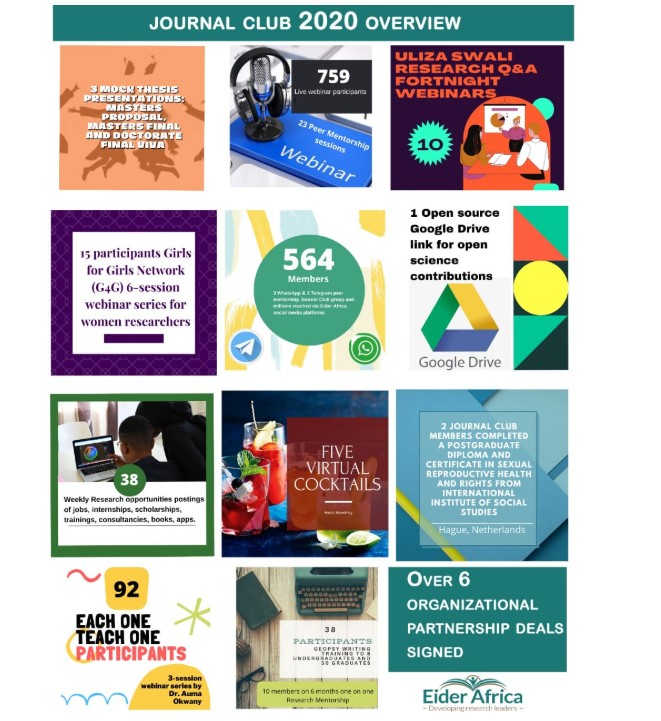
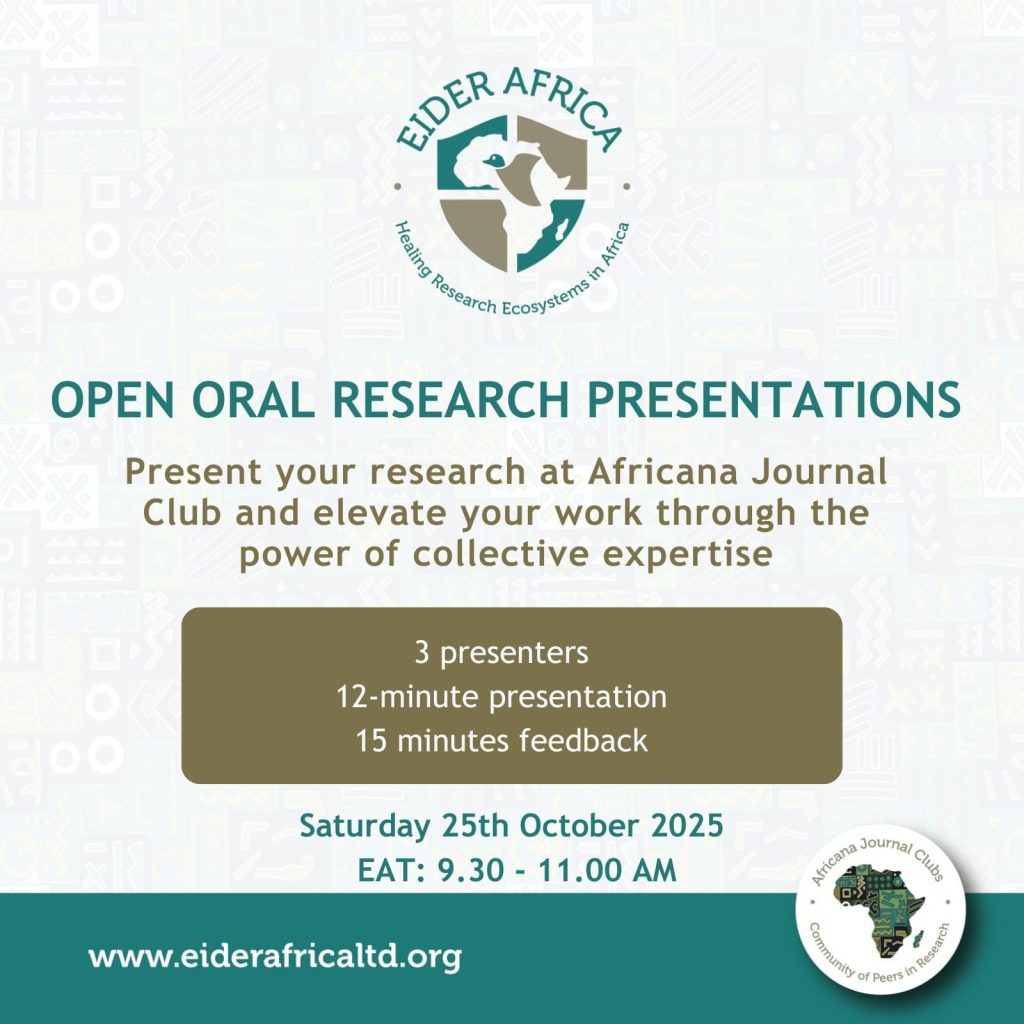
Fig 3: Eider Africa Peer Research Activities.
When I founded Eider Africa I chose to work outside the traditional university system, both physically and philosophically, while still maintaining connections with like-minded individuals within the academic infrastructures like Wambui Wamunyu who were also rethinking these issues. My perspective is that inclusive knowledge infrastructure should not look like a strongly established hierarchy where certain voices dominate postgraduate education and certain voices are systematically silenced. I aim to move beyond merely identifying the problem to highlight our work at Eider Africa where we are actively forging different pathways for collective knowledge creation, hearing postgraduate voices and research movements. But I want to make clear that what we are working to establish is not necessarily perfect but a first step to hold open possibilities for alternatives. I want to surface the inherent challenges within even these different spaces, particularly concerning mobilization, emotional, intellectual and physical labor, and confronting the dominant educational paradigm.
I will first explore what led me to found Eider Africa then how the journey has been.
- “To enter into the transformation, other people must come in, other people who have different ideas of living”. Prof. Odora Hoppers refers to higher education as a “banquet table”- “we must introduce new concepts to banquet table so that we are not just assimilated into it”- Reinforcing Higher Education in Africa. Eider Africa has set up a banquet table outside the university, inviting postgraduate students and other non-higher education actors to bring diverse voices together. Setting this table has been work of deep emotional labour, resilience and experimentation. Looking back my intention for this creative space is inspired by the words of Sylvia Tamale: “For the colonised, decolonisation of the mind is really about returning to the annals of history to find ourselves, to become fluent in our cultural knowledge systems, to cultivate critical consciousness and we reclaim humanity.”- Decolonization and Afri- Feminism
However, this is challenging because postgraduate students in the collective are part of an education system that encourages minimal interrogation and quick assimilation rather than deep reflection. The demands of modernity, capitalism, and career progression make it difficult for students to pause and critically examine history’s connection to their experiences. Despite these obstacles, the group actively promotes and emphasizes collaboration and mutual support over competition. Members are encouraged to take ownership of each other’s concerns and work together, whether through informal discussions or structured mentorship. We have named our collective the Africana Journal Club (a name that has evolved over time). The club has a membership of over 1000 members from 15 African countries. The group is supported by 4 people, 3 of whom receive an appreciation incentive. We leverage the collective knowledge of the group for mentorship, webinar presentation among other activities.
Analytical question 3: What specific challenges has Eider Africa faced over the past seven years, and what do these challenges reveal about the implications for developing alternative models of postgraduate education in Africa?
Artifact 3: Broken Pipeline: Higher Education and the Production of African
Development Researchers
Challenges of Creating Circular Peer-Led Spaces in Higher Education within a Dominant Pipeline Model
Critical commentary: The artifact was chosen because it sheds light on important concerns facing postgraduate education and provides a helpful perspective for comprehending the interrelated levels of issues Broken Pipeline: Higher Education and the Production of African Development Researchers. To frame these issues, it also makes use of the prevalent pipeline metaphor that is frequently employed in higher education. This linear framing limits how academic pathways and knowledge production are envisaged. Recent discussions are proposing other ways of reimagining this pipeline framing –From pipelines to pathways: Researchers call for a new approach to studying academic progress.
The pipeline framing contrasts with Eider Africa’s desire to co-create more circular open learning infrastructures that nurture transformation, exploration, imagination, and voice articulation. However, because pipeline framing is often presented as the most legitimatised approach to understand postgraduate education, it creates tensions and dilemmas for us at Eider Africa. At times, doubts emerge, making us question if we have veered off our decolonial and consciousness-raising agenda. On April 19th, 2024, feeling conflicted about the vision and reality of our work, I discussed these dilemmas with Angela Okune. My key takeaway was the immense value of such connections, including those with the Research Data Share collective team. These allies serve as crucial reminders that the struggle is worthwhile and that the continued decolonial agenda begins with us. I summarised the meeting with this statement that Angela captured.
“The missing link is that the true desire of why Eider was formed – to transform knowledge producers on the continent – has not been reflected in what we are doing. We have responded to what students need but we have not pushed their boundaries in ways that can bring this holistic change. We have not been working on changing them (raising consciousness). Just the status quo up to now. Now moving to the actual transformation agenda.”
In hindsight, leading through a transformative agenda we have to be careful and deeply reflexive to avoid alienating or silencing the very voices we aim to elevate and to avoid creating new hierarchies. Universities should not be the only spaces for these changes. We need to promote reflective habits not just at the university but in spaces such as Eider Africa collectives where we are seeking to build alternatives to ensure we stay active so as not be be co-opted by the same forces we are trying to resist.
- Working outside the dominant narrative and structures requires significant intellectual, physical, and emotional labor, which can be daunting. However, it also brings profound internal rewards and a sense of fulfilment. At Eider Africa carry an emotional load because we are committed to hearing the voices of postgraduate students who are often unheard or intentionally silenced within existing systems. Furthermore, our consistent experimentation and conscious reflection on our methods and motivations necessitate considerable intellectual seeking and shifts, leading to substantial intellectual labor.
Being a self-funded organization means the physical labor required to meet our needs is incredibly intense. I have consciously avoided seeking external funding, primarily because it’s difficult to find and sustain support for initiatives as fluid and adaptable as ours. I also recognize that most funding often comes with not just money but also control and a tendency to shift focus from original ideas, sometimes reducing students to mere numbers. This has made me cautious. However, I acknowledge that there are funders who could support our unique approach, one that values fluidity and experimentation. The challenge is, with such a lean team, the immense effort involved in searching for funding and writing proposals significantly hinders these crucial searches.
I have learnt a number of lessons from setting up a peer-learning space as an act of resistance. Building peer relationships as knowledge making and resistance is a continuous endeavour of caring, giving, nurturing and reflexivity. Resistance in this space is not visible pressure, it is more subtle, often unseen, unclear and prioritises the invisible changes within students on self-reassurance, trusting their voices and trusting others. This approach shifts focus away from the university as the sole space for knowledge production, learning, nurturing. It highlights the importance of creating and valuing spaces where researchers can convene and grow.
References
Adong, A., & Posner, D. N. (2025, November 3). Broken Pipeline: Higher Education and the Production of African Development Researchers (Unpublished manuscript). Center for Population and Applied Statistics, Makerere University & Department of Political Science, University of California, Los Angeles. Retrieved from http://danielnposner.com/wp-content/uploads/2025/11/Broken-Pipeline-251103.pdf
Cook-Sather, A. (2006). Sound, presence, and power: “Student voice” in educational research and reform. Curriculum Inquiry, 36(4), 359–390. https://doi.org/10.1111/j.1467-873X.2006.00363.x
Daley, P. (2020). Intervention Defiant scholarship: Learning from African intellectuals.
Antipode Online.
De Sousa Santos, B. (2014). Epistemologies of the South: Justice against epistemicide. Routledge.
Mamdani, M. (2007). Scholars in the marketplace: The dilemmas of neo-liberal reform at Makerere University, 1989–2005. CODESRIA.
Mbembe, A. (2016). Decolonizing the university: New directions. Arts and Humanities in Higher Education, 15(1), 29–45.
Muthiani, A. K., Muthima, P. W., & Itolondo, W. A. (2022). Research skill determinants and completion rate among postgraduate students in School of Education, Kenyatta University, Kenya. Journal of the Kenya National Commission for UNESCO, 2(1), July–December 2022. ISSN 2958-7999.
Munene, A. (2024). Contextually grounded research in postgraduate research training in Africa: Why and how. In P. S. Forscher & M. Schmidt (Eds.), A better how: Notes on developmental meta-research (pp. 111–125). Busara.
https://doi.org/10.62372/ISCI6112
Ochwa-Echel, J. R. (2013). Neoliberalism and university education in sub-Saharan Africa. Journal of Pan African Studies, 6(4), 114–128.
Omedi, G., Mwaila, M., & Wanja, S. (2025). Delayed completion of graduate studies: An assessment of the growing academic demands. International Journal of Research and Innovation in Social Science, 9(3S), 7161–7173.
https://doi.org/10.47772/IJRISS.2025.903SEDU0532
Spector, C. (2023, April 27). From pipelines to pathways: Researchers call for a new approach to studying academic progress. Stanford Graduate School of Education.
https://ed.stanford.edu/news/pipelines-pathways-researchers-call-new-approach-studying-academic-progress
Tamale, S. (2020). Decolonization and Afro-feminism. Daraja Press.
UNESCO. (2023, September 21). Reinforcing higher education in Africa.
Waninga, W., Wekoye, C., Kulwenza, R., Atabo, H., Nambogwe, E., Olupot, A., Nadunga, B., Alem, T., Weswa, C., & Nandutu, R. (2025). The politics of knowledge: Power, epistemic coloniality, and publication dynamics in African higher education. Journal of Education and Practice, 9(5), 31–46. ISSN 2520-467X. View of The Politics of Knowledge: Power, Epistemic Coloniality, and Publication Dynamics in African Higher Education