

By: Angela Okune
The politics of African knowledge production do not reside only in who publishes, but in who owns and governs the infrastructures through which publishing happens. As African scholars adopt the seemingly neutral technical standards of “mainstream” global publishing systems, we enroll our work into systems of data analytics, valuation, and profit extraction that were not designed for our benefit. This data essay examines the Digital Object Identifier (DOI) as one such infrastructural device: a seemingly neutral technical standard that stabilizes scholarly communication while consolidating control over how knowledge circulates and accrues value.
Context
I have long been concerned with how research practices in Kenya are experienced as extractive and with whether more open sharing might refresh the social contract of qualitative research (Okune 2020). Recent calls to make science more “equitable and inclusive” (Raju et al. 2023) often focus on representation: who is visible, indexed and counted. But inclusion within infrastructures governed elsewhere is not autonomy. As Paulin Hountondji (1990) warned in his critique of scientific extroversion, participation in externally defined systems may actually deepen dependence rather than resolve it.
Consider the launch of Scientific African in 2018, an open-access journal dedicated to African research and widely celebrated as a milestone. Its editor-in-chief proclaimed: “This is the place for scientists who want to create the Africa we want to stand up and be counted.” Yet, the journal is published by Elsevier and requires an Article Processing Charge (APC) of nearly $600 per article. The fee is not only a financial barrier. Publication enrolls these knowledge outputs into a DOI-based ecosystem of citation tracking, metadata aggregation, and ranking infrastructures governed by commercial actors. African scholarship becomes legible within global metrics systems, but on terms set elsewhere. Visibility on the global scientific stage is secured through infrastructural compliance.
A small group of multinational publishers has dominated scholarly publishing since at least the 1970s (Larivière et al., 2015). Even as they open their platforms to authors from the so-called “global South,” they retain control over the infrastructures, standards, and data pipelines that shape scholarly value. This, I argue, is why as critical scholars, we cannot be satisfied only with greater representation in existing systems of publishing.
The Case of the DOI
The dominance of major commercial publishers has drawn increasing critique (van Bellen et al., 2024; Posada & Chen, 2018), but less scholarly attention has been paid to the political economy of the infrastructures that sustain that dominance. The DOI is part of this infrastructure, a type of permanent, unique identifier assigned to a digital work like a journal article, dataset, or report. It provides a stable link so the item can always be found online, even if its web address changes.
At face value, the DOI may sound like a neutral technical object, but it is in fact a strong example of how infrastructural design encodes power. The DOI is not just a technical convenience; it is a central organizing mechanism of global scholarly communication, meant to streamline rights management and revenue collection for established dominant publishers. Writing as a participant in the process, Bill Rosenblatt (1997) explained that the DOI was invented to ensure that all publishers backed the same technical object: “Adopting electronic-publishing solutions based on common open standards increases the likelihood that publishers’ capital investments will pay off. It helps ensure that publishers will be able to extend their franchises into cyberspace, where much of the world of information is surely going.”
Consequences for African Knowledge Systems
When the “problem” of African Knowledge Systems is framed as under-representation (too few African outputs indexed in global science), then the solution that follows is a technical one: make African works more visible. Outputs that cannot be easily assigned identifiers (oral histories, community reports, indigenous knowledge systems, and policy-relevant grey literature) become ripe to be translated into DOI-compatible objects to be “counted.” This is exactly what we are seeing with the recent rise of the Africa PID Alliance, which emerged out of a supposed need to better identify and track “Indigenous Knowledge” in Africa and ensure intellectual property (IP) rights are properly assigned to the original holders. Such an IP paradigm, centered on visibility and individual ownership, flows directly from commercial publishing logics and is at odds with indigenous knowledge traditions of collective stewardship. When indigenous knowledge, oral histories, or community-generated materials are assigned DOIs, they become translated into objects compatible with global metadata schemas, citation systems, and intellectual property regimes. The DOI therefore does not just enable visibility, it reconstitutes knowledge into forms legible to and valuable for commercial publishing systems.
But is visibility and representation on the global stage the actual problem plaguing African knowledge systems? As my collaborators explain elsewhere in this book (Munene 2026; Wamunyu 2026), the deeper challenges facing African knowledge systems are not about volume or visibility. They concern autonomy, confidence, institutional capacity, and the long histories that continue to structure whose standards define legitimate knowledge. Technical fixes cannot resolve these structural and psychological dimensions.
Through the curation and close reading of data artifacts below which include DOI governance documents, early promotional materials, and contemporary critical reflections, I trace how the DOI rose to dominance among a range of persistent identifier (PID) schemes. I hope this analysis reveals how mundane technical decisions carry significant geopolitical and economic consequences, structuring whose knowledge circulates, under what terms, and to whose benefit.
Alternatives Exist
Importantly, the DOI is not the only possible infrastructure. The ARK (Archival Resource Key) system is one example of an alternative model built on principles of decentralization, institutional autonomy, and openness. Unlike DOIs, ARKs do not have usage fees and allow institutions to maintain control over their own identifier namespaces, resisting the commodification of scholarly infrastructure and reasserting knowledge as a public good. This contrast shows that knowledge infrastructures should be the grounds for active struggle and imagination of our knowledge futures.
The ARK system is significant not only in its technical design, but because of the governance model it enables. By allowing institutions to control their own identifier namespaces, ARKs offer a way for African universities, libraries, and archives to assert epistemic autonomy without withdrawing from global knowledge exchange. In other words, it is not a binary choice – to only look inwards and reject interoperability or to be fully assimilated into global publishing infrastructures. ARKs represent a possible alternative to DOI-based infrastructures and a step toward greater institutional control.
In Closing
Greater visibility of diverse scholars should not be the end goal of scholarly publishing. Rather, ownership and decision-making by scholars of their own publishing infrastructure should be the goal. It is not enough to be guests allowed into someone else’s house (i.e. African authors accepted onto global scholarly publishing platforms). We must own our own house if we want the power (and responsibility) to decide what is housed in it, who is welcomed in and on what terms. This does not necessarily mean abandoning global infrastructures, rather it requires negotiating from a position of governance rather than compliance.
Those committed to dismantling inequalities in global science need to attend not only to issues of representation (who gets to publish and be cited) but also to deeper questions of ownership and benefit. While calls for more African research are understandable, this requires we go beyond increasing outputs within unjust systems and instead invest in building alternative infrastructures, norms, and practices that enable us to “do and be otherwise.” Without rethinking the scholarly infrastructures through which we publish and connect, we risk further entrenching imperial systems under the guise of progress.
Source Data
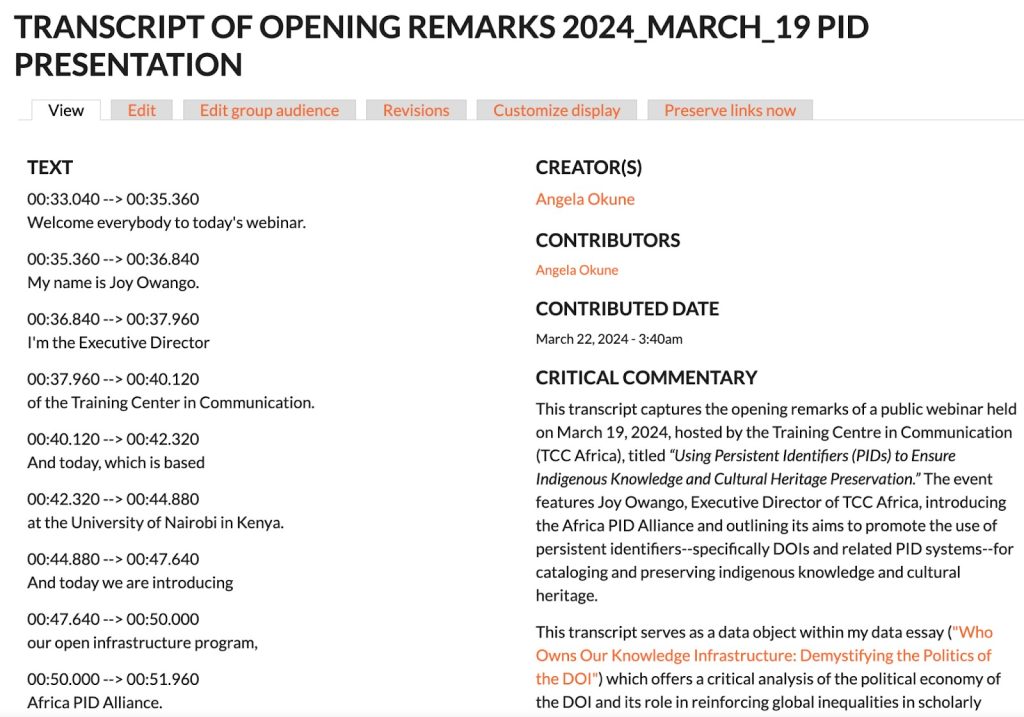
Critical Commentary: This transcript captures the opening remarks of a public webinar held on March 19, 2024, hosted by the Training Centre in Communication (TCC Africa), titled “Using Persistent Identifiers (PIDs) to Ensure Indigenous Knowledge and Cultural Heritage Preservation.” The event features Joy Owango, Executive Director of TCC Africa, introducing the Africa PID Alliance and outlining its aims to promote the use of persistent identifiers, specifically DOIs and related PID systems, for cataloging and preserving indigenous knowledge and cultural heritage.
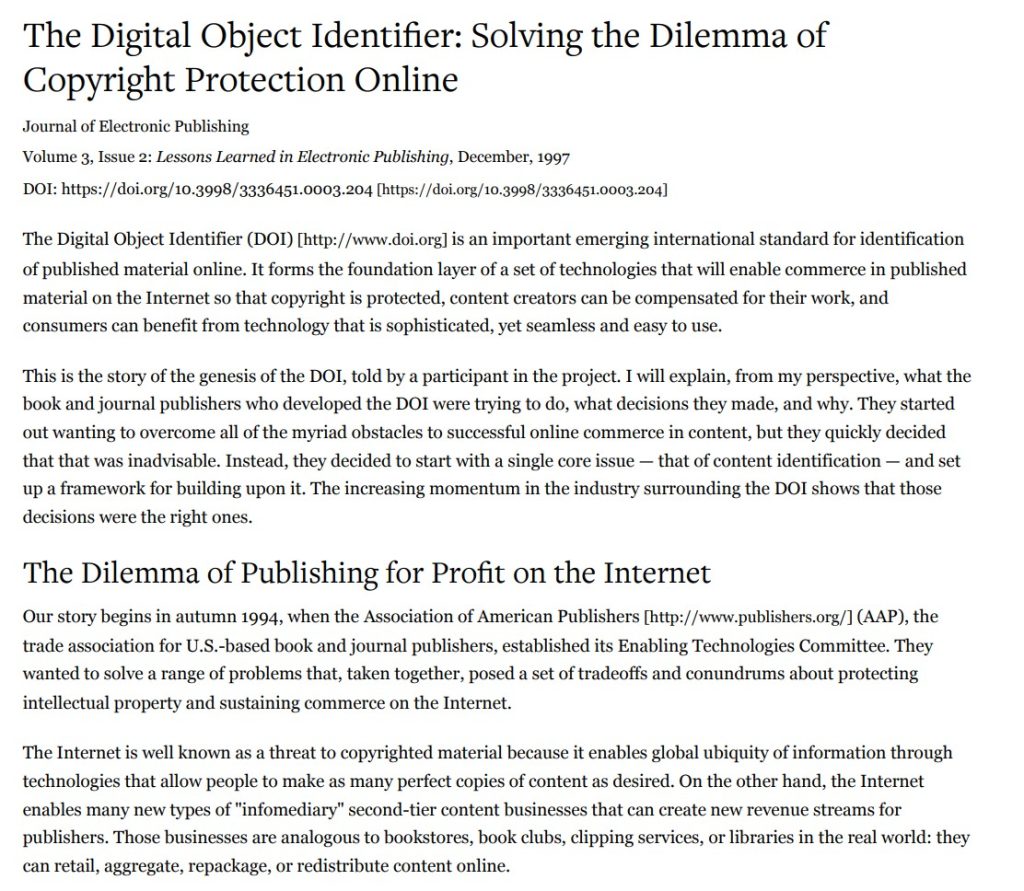
Critical Commentary: This 1997 article offers a firsthand account of the genesis of the DOI, explicitly described by the author as “told by a participant in the project.” The article details how major commercial book and journal publishers conceptualized the DOI, the motivations driving their decisions, and the strategic interests they aimed to protect. Rosenblatt frames the DOI as a tool for ensuring that publishers “dance to the same rhythm” in the emerging digital landscape. He describes the DOI as a mechanism designed to protect their market dominance and secure profitability as publishing moved online. He closes by affirming that the DOI helps publishers “extend their franchises into cyberspace,” underscoring its role in preserving and amplifying existing commercial models rather than opening new possibilities for knowledge sharing.
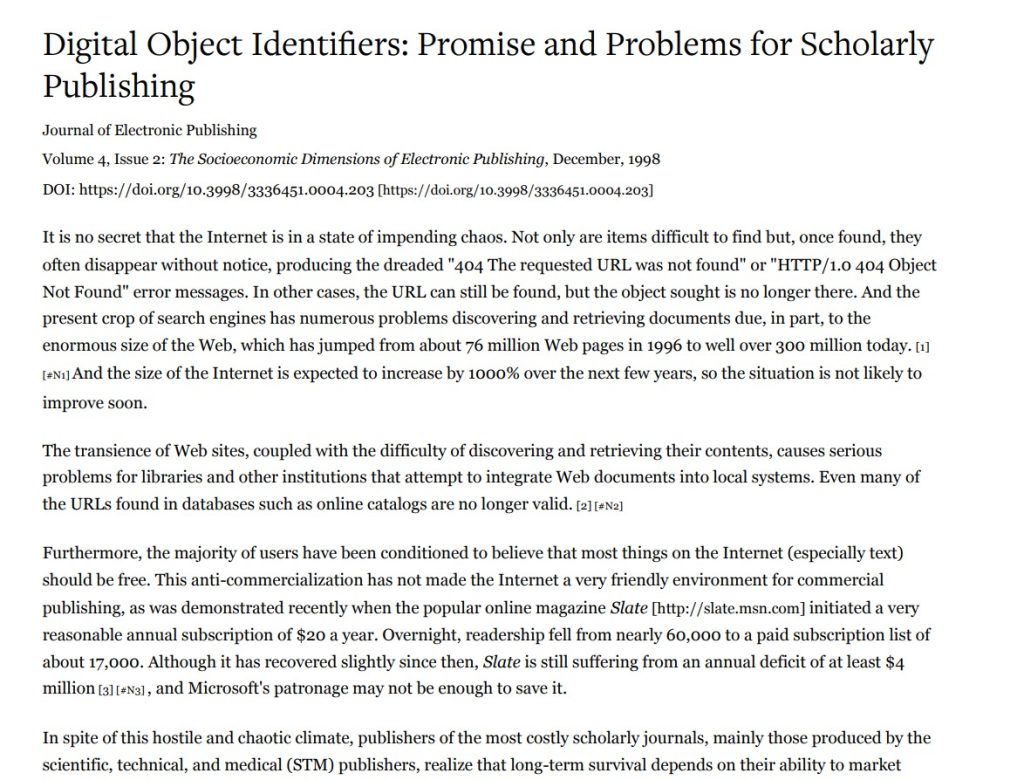
Critical Commentary: This 1998 article “Digital Object Identifiers: Promise and Problems for Scholarly Publishing,” offers a detailed account of the early development and institutionalization of the DOI system. Drawing from events in the mid-1990s, the authors provide historical insights into the founding of the International DOI Foundation (IDF), including its original mission statement: “to ensure that the system meets the needs of publishers.” This explicit prioritization of commercial publisher interests was later quietly removed from the IDF website, signaling both the original orientation of the DOI toward protecting publishing industry profitability and the subsequent effort to obscure these origins.
Digital Object Identifiers session at American Library Association. 1998.
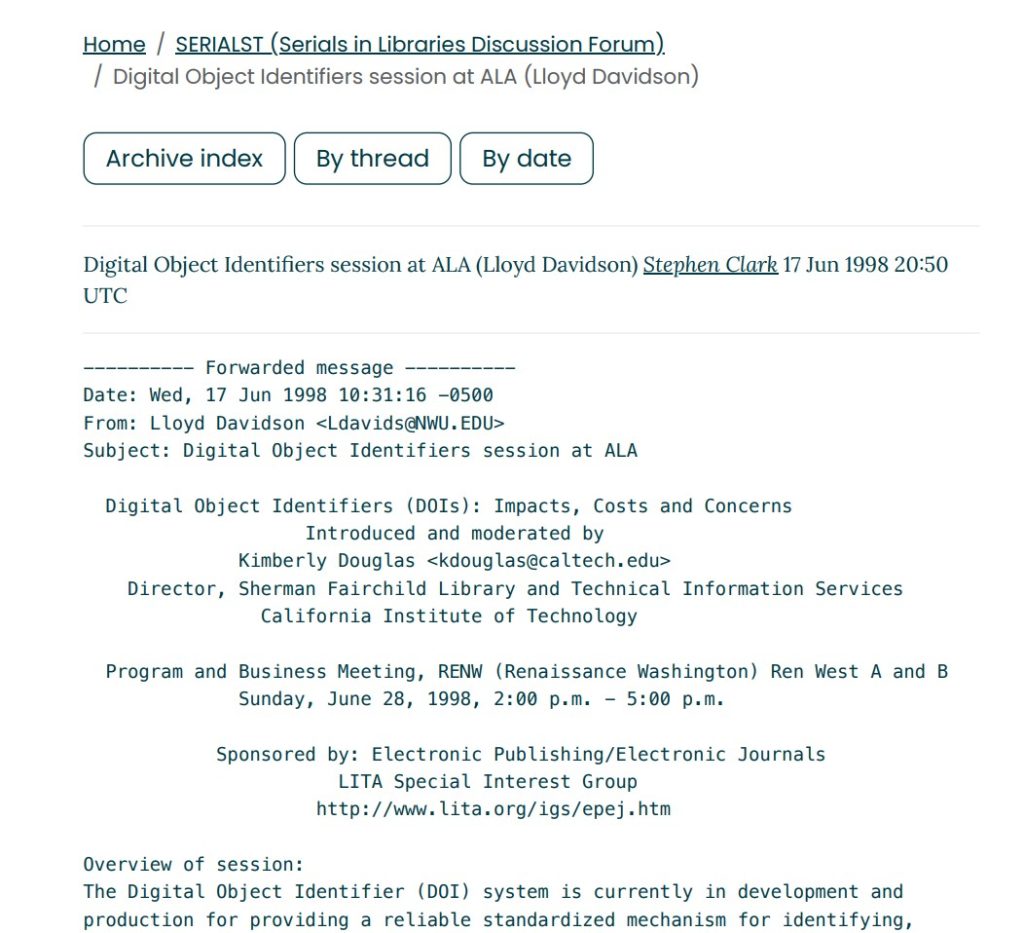
Critical Commentary: This 1998 email announcement details a panel session on Digital Object Identifiers (DOIs) organized by Lloyd Davidson for the American Library Association (ALA) annual meeting. Titled “Digital Object Identifiers: Impacts, Costs and Concerns,” the session brought together early stakeholders in the DOI system, including representatives from Sun Microsystems, the International DOI Foundation, R.R. Bowker, and several U.S. academic libraries, to discuss the technical architecture, governance, and commercial potential of the DOI. The announcement also includes a curated bibliography of foundational articles and publisher case studies on DOI development and implementation.
Kunze, John. 2024. “Getting Started with ARK Persistent Identifiers.”
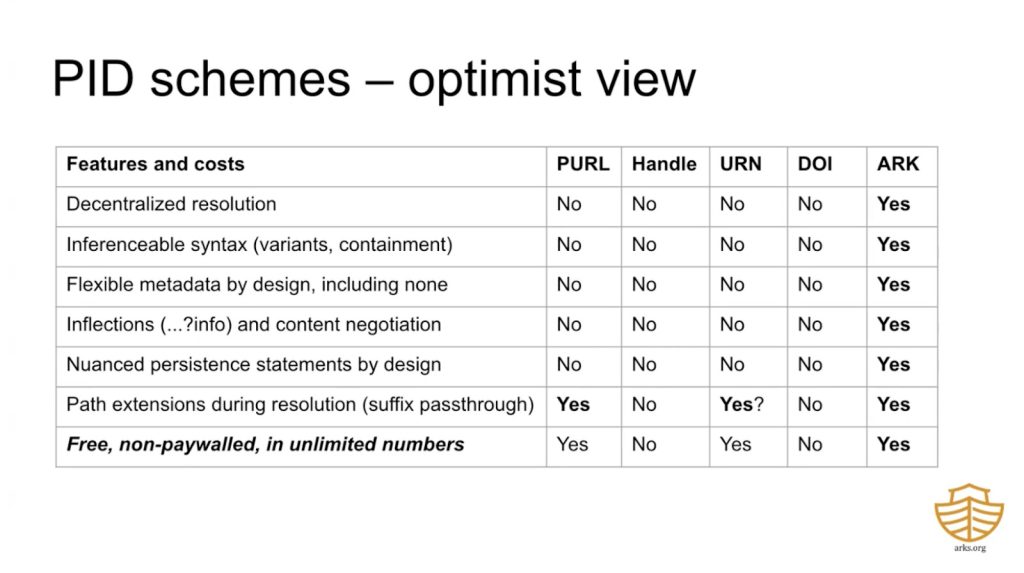
Critical Commentary: This video, created by John Kunze, provides an introduction to Archival Resource Keys (ARKs) and the broader landscape of persistent identifier (PID) schemes. Kunze, a key figure in the development of ARKs, outlines their technical design, governance philosophy, and practical advantages over more commercialized systems like the DOI. The presentation emphasizes ARKs’ commitment to decentralization, institutional autonomy, and affordability, positioning them as a non-proprietary alternative for managing digital resources.
Analytic Questions
How are technical infrastructures described in terms of their purpose, scope, and impact?
- The digital infrastructure is presented as a neutral and technical solution to knowledge management. Owango asserts, “we are literally leveraging on existing technology to produce our digital object container,” framing this as a pragmatic inevitability. However, the proposed system explicitly makes indigenous knowledge legible through its incorporation into existing global classification schemes, “Visualize the digital object container… and you have your indigenous knowledge… If there’s any publication… there’s an ID assigned to it.” Read more.
How is the research and/or publishing environment characterized?
- Rosenblatt presents the publishing environment as a commercial ecosystem under threat from the unregulated, “open” nature of the Internet. The DOI is introduced explicitly as a solution to “facilitate commerce in published material on the Internet” and secure intellectual property rights. Read more.
- Davidson & Douglas characterizes the fear that the dominant commercial publishers felt when the World Wide Web was first launched. The authors portrays the late-1990s digital publishing landscape as chaotic and unstable, emphasizing issues like the transience of web content, broken links, and the difficulty of discovering and retrieving documents online. Read more.
References
African PID Alliance. (n.d.). Infrastructure framework. https://docid.africapidalliance.org/infrastructure-framework
Achieng, S. (2019, March 18). Scientific African is showcasing R&D for impact. SciDev.Net. https://www.scidev.net/sub-saharan-africa/opinions/scientific-african-is-showcasing-r-d-for-impact/
Hountondji, P. J. (1990). Scientific dependence in Africa today. Research in African Literatures, 21(3), 5–15.
Larivière, V., Haustein, S., & Mongeon, P. (2015). The oligopoly of academic publishers in the digital era. PLOS ONE, 10(6), e0127502. https://doi.org/10.1371/journal.pone.0127502
Okune, A. (2020). Open ethnographic archiving as feminist, decolonizing practice. Catalyst: Feminism, Theory, Technoscience, 6(2), Article 2. https://doi.org/10.28968/cftt.v6i2.33041
Posada, A., & Chen, G. (2018, June 15). Inequality in knowledge production: The integration of academic infrastructure by big publishers. Paper presented at the 22nd International Conference on Electronic Publishing (ELPUB 2018). https://doi.org/10.4000/proceedings.elpub.2018.30
Raju, R. (2023). The role of African research in global scholarly communication: Towards bibliodiversity and epistemic justice. Publications, 11(3), 36. https://doi.org/10.3390/publications11030036
Rosenblatt, B. (1997). The digital object identifier: Solving the dilemma of copyright protection online. The Journal of Electronic Publishing, 3(2). https://doi.org/10.3998/3336451.0003.204
van Bellen, S., Alperin, J. P., & Larivière, V. (2024). The oligopoly of academic publishers persists in exclusive database (Version 1) [Preprint]. arXiv. https://doi.org/10.48550/arXiv.2406.17893